For patients looking for non-surgical lifting without incisions or sutures, Ulthera offers an ultrasound-based approach to skin tightening and lifting. At Signal Plastic Surgery in Busan, Ulthera treatment is planned according to the areas of facial or neck laxity that need to be addressed, using real-time ultrasound visualization to guide energy delivery.
Ulthera is an FDA-cleared ultrasound lifting device that allows the practitioner to visualize tissue layers during treatment and deliver focused ultrasound energy at selected depths, including the SMAS (superficial musculoaponeurotic system) level.
For international patients considering Ulthera in Korea, understanding this visualization system and how the treatment is planned is more important than simply comparing the number of shots.
- What Is Ulthera?
- How Does Ulthera Work?
- Ulthera in Busan: Why Real-Time Visualization Matters
- What Areas Can Be Treated With Ulthera?
- Who May Consider Ulthera?
- How Signal Plastic Surgery Plans Ulthera Treatment
- What to Expect From Ulthera at Signal Plastic Surgery
- When Will I See Results From Ulthera?
- Before & After Ulthera
- Original Ulthera at Signal Plastic Surgery
- Frequently Asked Questions About Ulthera
- Considering Ulthera at Signal Plastic Surgery in Busan?
What Is Ulthera?
Ulthera is the original microfocused ultrasound system used for non-invasive lifting and tightening.
Unlike a surgical facelift, the treatment does not involve skin incisions. Instead, focused ultrasound energy is delivered beneath the skin to targeted tissue depths.
One of the defining features of Ulthera is its real-time ultrasound imaging system, often referred to as See & Treat.
This allows the treatment provider to visualize the tissue being treated before delivering ultrasound energy, helping determine the appropriate treatment depth for the targeted area.
The treatment is designed for patients who want to address facial or neck laxity without surgery and without the recovery requirements associated with an incision.

How Does Ulthera Work?
Ulthera uses microfocused ultrasound energy delivered beneath the surface of the skin.
The treatment process can be understood in three steps:
1. Visualize the Tissue
The ultrasound imaging system allows the practitioner to view tissue layers beneath the skin in real time.
2. Select the Treatment Depth
Different areas of the face have different anatomical structures and tissue thicknesses.
The treatment plan therefore needs to consider where the energy should be delivered rather than treating every area at exactly the same depth.
3. Deliver Focused Ultrasound Energy
Ultrasound energy is delivered to targeted tissue layers, including deeper supporting structures such as the SMAS layer.
This controlled thermal stimulation initiates a tissue response that can gradually contribute to tightening and lifting.
Because the treatment works beneath the surface, visible changes are not necessarily immediate or final on the day of treatment.
Ulthera in Busan: Why Real-Time Visualization Matters
A key feature that distinguishes Ulthera from many other ultrasound-based lifting treatments is the ability to see the tissue layers during treatment.
This matters because facial anatomy is not identical from one patient to another—or even from one area of the same face to another.
Real-time visualization can help the practitioner identify the tissue layer being targeted before delivering energy.
For this reason, Ulthera treatment should not be viewed simply as:
“How many shots am I getting?”
A more useful question is:
“Where are the shots being delivered, at what depth, and why?”
Treatment planning should consider the patient’s anatomy, degree of laxity, treatment area, and lifting goals.
What Areas Can Be Treated With Ulthera?
At Signal Plastic Surgery, Ulthera may be used for several areas of the face and neck.
Jawline and Cheeks
Ulthera may be considered when laxity around the lower face makes the facial contour appear less defined.
Treatment can be planned around the cheeks and jawline according to the patient’s facial structure and areas of concern.
Forehead and Brow Area
Ulthera can also be used around selected areas of the upper face, including the forehead and brow region.
Because the anatomy around the eyes requires particular consideration, treatment location and depth should be determined individually.
Double Chin Area
For patients concerned about a less defined area beneath the chin, Ulthera may be incorporated into a lower-face treatment plan.
However, not every double chin has the same cause. Fat volume, skin laxity, and facial structure can contribute differently to the appearance of the area.
Neck
Ulthera may be used to address skin laxity and lines around the neck as part of a non-surgical lifting plan.
Who May Consider Ulthera?
Ulthera may be considered for patients who:
- Want noticeable lifting without surgery
- Are concerned about deeper facial or neck laxity
- Feel their facial contour or jawline has become less defined
- Prefer a treatment designed to provide gradual, longer-lasting improvement
- Want a non-incisional lifting option with minimal disruption to daily activities
However, Ulthera is not automatically the appropriate treatment for every type or degree of facial sagging.
The cause and severity of the concern should be assessed before treatment. Patients with more significant tissue laxity may need to discuss whether a non-surgical procedure can realistically provide the degree of change they expect.
How Signal Plastic Surgery Plans Ulthera Treatment
More shots do not automatically mean a better Ulthera result.
The treatment plan should instead consider where energy needs to be delivered and which tissue depth should be targeted.
At Signal Plastic Surgery, Ulthera planning may take into account:
- Area of facial or neck laxity
- Facial contour
- Tissue depth
- Treatment area
- Degree of sagging
- Desired lifting effect
Real-time ultrasound visualization is then used during treatment to identify the targeted tissue layers.
This is especially relevant for international patients comparing Ulthera in Korea, where clinics may offer different treatment plans and shot counts.
Rather than comparing shot numbers alone, patients should understand how the treatment will be planned for their individual anatomy.
What to Expect From Ulthera at Signal Plastic Surgery
Ulthera is a non-surgical procedure and does not require hospitalization, sutures, or routine postoperative wound treatment.
| Treatment Information | General Guide |
|---|---|
| Treatment Time | Approximately 30 minutes |
| Anesthesia | Not required |
| Hospitalization | Not required |
| Suture Removal | Not applicable |
| Routine Follow-Up Treatment | Not required |
Individual treatment time may vary depending on the treatment area and plan.
When Will I See Results From Ulthera?
Ulthera should not be evaluated in the same way as a surgical facelift.
Because focused ultrasound treatment works by stimulating a gradual tissue response, changes may continue to develop after treatment rather than appearing all at once.
The degree and duration of improvement can also vary depending on factors such as:
- Age
- Skin and tissue condition
- Degree of laxity
- Treatment area
- Individual biological response
Ulthera may be appealing to patients looking for a non-surgical treatment with a longer-lasting effect, but no non-surgical lifting procedure should be expected to produce the same degree of structural change as facelift surgery.
Before & After Ulthera
Before-and-after photographs can help demonstrate the type and degree of change that may occur after Ulthera treatment.
When reviewing Ulthera cases, it can be useful to look beyond the face as a whole and compare specific areas such as:
- Jawline definition
- Lower-face contour
- Cheek laxity
- Area beneath the chin
- Brow position
- Neck contour
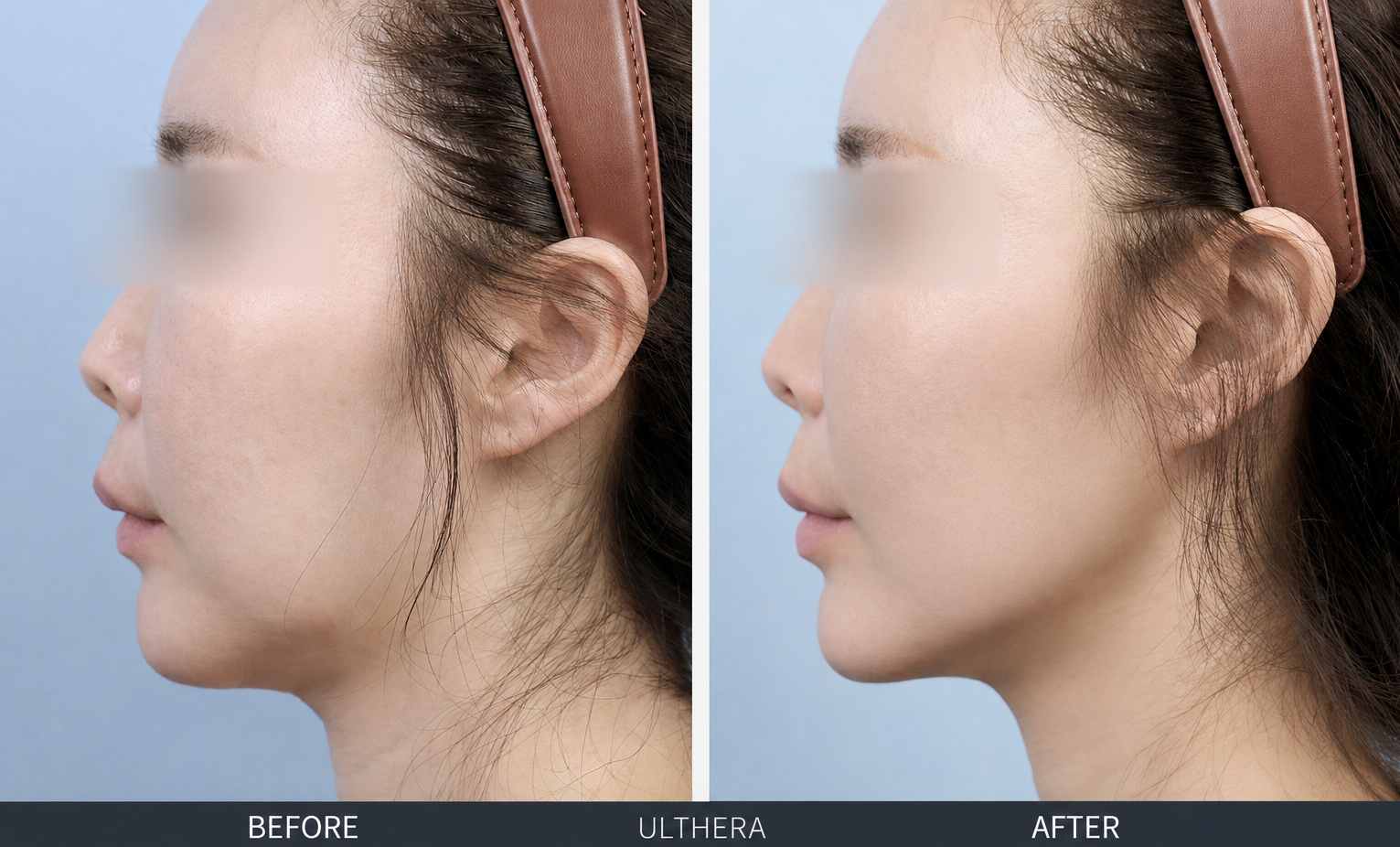
Individual results vary. Before-and-after photographs represent individual cases and do not guarantee the same result for every patient.
Original Ulthera at Signal Plastic Surgery
For international patients researching aesthetic treatments in Korea, verifying the device being used can be an important part of choosing a clinic.
Signal Plastic Surgery is an officially certified clinic using genuine Ulthera equipment.
Ulthera treatment at Signal Plastic Surgery is provided under the care of a board-certified plastic surgeon who also holds a PhD in Medicine.
This is particularly relevant because non-surgical lifting is not simply about operating a device. Facial anatomy, tissue distribution, areas of laxity, and the appropriate treatment depth all influence how a treatment plan should be designed.
Signal Plastic Surgery therefore approaches Ulthera as an anatomy-based lifting treatment rather than focusing solely on shot count.
Frequently Asked Questions About Ulthera
Is Ulthera the same as HIFU?
Ulthera uses microfocused ultrasound technology and belongs to the broader category of ultrasound-based lifting treatments often discussed as HIFU.
However, Ulthera is a specific device with real-time ultrasound visualization that allows the practitioner to view tissue layers during treatment.
For patients comparing ultrasound lifting treatments, it is useful to compare the actual device, visualization capabilities, treatment depths, and treatment plan rather than relying only on the general term “HIFU.”
How many Ulthera shots do I need?
There is no single shot count that is appropriate for every patient.
The number of shots may depend on the treatment area, facial anatomy, degree of laxity, and treatment goals.
More shots do not automatically produce a better result. The location and depth of energy delivery are also important considerations.
Does Ulthera hurt?
Individual experiences vary.
Focused ultrasound energy is delivered beneath the skin, so patients may experience sensations such as heat, tingling, or brief discomfort during treatment.
Pain sensitivity varies between individuals, and patients concerned about discomfort should discuss this with the medical team before treatment.
Is Ulthera good for a sagging jawline or double chin?
Ulthera may be considered when skin or deeper tissue laxity contributes to reduced jawline definition.
However, a double chin can also be influenced by fat volume and underlying facial structure. If excess fat rather than laxity is the primary concern, Ulthera alone may not necessarily address everything the patient wants to change.
An assessment is therefore useful before choosing a treatment based only on the appearance of the jawline.
Is one Ulthera treatment enough?
Ulthera is often chosen by patients looking for meaningful improvement from a single treatment session, but the appropriate treatment frequency varies.
Age, tissue condition, degree of laxity, previous treatments, and individual response can all influence whether and when another treatment may be considered.
How long does Ulthera last?
The duration of visible improvement varies between individuals.
Ulthera stimulates a gradual tissue response rather than creating a permanent mechanical lift. Aging also continues after treatment, so results should not be considered permanent.
Patients looking for a longer-lasting non-surgical lifting option should discuss their tissue condition and expectations during consultation rather than relying on a fixed duration that may not apply to everyone.
Is Ulthera worth getting during a trip to Korea?
For some international patients, Ulthera can be convenient because it is non-surgical and does not require hospitalization, sutures, or routine wound treatment.
However, treatment should still be selected according to the patient’s actual facial concerns rather than simply because it can fit into a travel itinerary.
If you are considering Ulthera in Busan, it is useful to have your facial laxity, treatment areas, and expectations assessed before deciding on a treatment plan.
How can I tell if a clinic in Korea is using genuine Ulthera?
Patients can ask the clinic whether it uses an authentic Ulthera device and whether it is officially recognized as a genuine-device provider.
Signal Plastic Surgery is a certified clinic using genuine Ulthera equipment.
For international patients researching Ulthera in Korea, checking the actual device is a useful step rather than assuming every ultrasound lifting treatment advertised as “Ulthera-like” is the same system.
Should I choose Ulthera or a surgical facelift?
They address different levels of concern and should not be considered interchangeable treatments.
Ulthera is a non-surgical option for patients who may benefit from ultrasound-based tightening and lifting. Facelift surgery can address more significant tissue laxity through surgical repositioning.
If the main concern is substantial sagging, a consultation can help determine whether a non-surgical treatment is likely to provide the degree of change the patient expects.
Considering Ulthera at Signal Plastic Surgery in Busan?
If you are considering Ulthera, choosing a treatment based only on the lowest price or highest shot count may not tell you whether the treatment is appropriate for your face.
A more useful starting point is:
“Which areas are actually sagging, and at what tissue depth should they be treated?”
At Signal Plastic Surgery, patients can discuss their main areas of concern, desired degree of lifting, previous lifting treatments, and expectations with the medical team before establishing an individualized Ulthera plan.
For international patients considering Ulthera in Busan, this also provides an opportunity to confirm the genuine Ulthera device and understand how treatment will be planned for their individual facial anatomy.