Thinking about getting double eyelid surgery in Korea but unsure whether to choose the incisional or non-incisional method?
Both techniques are designed to create or refine an upper eyelid crease, but they differ in how the crease is formed, which eyelid conditions they can address, and how recovery progresses.
Some patients want a natural-looking eyelid crease that complements their existing eye shape. Others are concerned about thick eyelids, excess skin, uneven eyelid creases, or a tired-looking appearance.
The best surgical approach depends on more than personal preference.
At Signal Plastic Surgery in Busan, board-certified plastic surgeon Dr. Kyung Wook Nam provides individualized eye surgery consultations, including primary double eyelid surgery and complex revision eye procedures.
In this guide, we’ll explore incisional vs non-incisional double eyelid surgery in Korea, including techniques, suitable candidates, costs, recovery, and what international patients should know before booking.
- What Is Double Eyelid Surgery?
- Double Eyelid Surgery in Korea: Procedure Information & Cost
- Incisional Double Eyelid Surgery: Who Is It Best For?
- Non-Incisional Double Eyelid Surgery: Who Is It Best For?
- Double Eyelid Surgery Before & After: What Results Can You Expect?
- Why Choose Signal Plastic Surgery for Double Eyelid Surgery in Busan?
- Planning Double Eyelid Surgery in Korea as an International Patient
- Frequently Asked Questions About Double Eyelid Surgery in Korea
- Considering Double Eyelid Surgery in Busan? Consult Signal Plastic Surgery
What Is Double Eyelid Surgery?
Double eyelid surgery, also known as Asian blepharoplasty, is a cosmetic procedure that creates or adjusts the upper eyelid crease.
The procedure may help patients achieve a more defined eyelid contour while maintaining facial harmony and their natural eye shape.
However, not everyone wants the same result.
Some patients prefer a subtle, natural-looking crease, while others want a more visible eyelid fold.
Factors such as eyelid skin thickness, excess fat, skin laxity, and eyelid-opening muscle function influence which technique may be appropriate.
The two main approaches are:
- Incisional Double Eyelid Surgery: Creates the eyelid crease through an incision, allowing the surgeon to address selected excess skin and underlying tissues.
- Non-Incisional Double Eyelid Surgery: Uses strategically placed sutures to create connections between eyelid tissues without a full-length skin incision.
Neither method is universally better. The appropriate technique depends on the patient’s eyelid anatomy and desired outcome.

Double Eyelid Surgery in Korea: Procedure Information & Cost
At Signal Plastic Surgery, both incisional and non-incisional double eyelid surgery are available following a consultation with a board-certified plastic surgeon.
The following table summarizes the clinic’s general procedure information and pricing.
| Information | Incisional Double Eyelid Surgery | Non-Incisional Double Eyelid Surgery |
|---|---|---|
| Procedure | Incisional technique | Suture-based, non-incisional technique |
| Main Approach | Creates a crease through an incision and allows selected tissue adjustment | Creates a crease using strategically placed sutures and tissue adhesion |
| Surgery Duration | Approximately 30–90 minutes | Approximately 30–90 minutes |
| Anesthesia | Sedation | Sedation |
| Hospital Admission | Same-day discharge | Same-day discharge |
| General Recovery Period | Approximately 1–2 weeks | Approximately 1–2 weeks |
| Follow-Up Visits | Approximately 2–3 visits | Approximately 2–3 visits |
| Approximate Cost | KRW 1,650,000 | KRW 1,155,000 |
The surgery duration, anesthesia, discharge, recovery, and follow-up information reflects the clinic’s general double eyelid surgery guidance rather than separate confirmed schedules for each technique. Actual arrangements may differ depending on the surgical plan.
Prices are reference amounts and should be reconfirmed before booking. Additional procedures, such as ptosis correction or canthoplasty, may affect the total cost.
Incisional Double Eyelid Surgery: Who Is It Best For?
Incisional double eyelid surgery creates an upper eyelid crease through a planned incision.
At Signal Plastic Surgery, the approach may involve preserving the intended crease design while removing selected excess skin covering the upper eyelid and adjusting the crease position.
The surgeon carefully considers eyelid thickness, skin tension, and crease height to reduce the risk of an excessively thick or unnatural-looking fold.
This is particularly important because creating a higher eyelid crease does not automatically produce a better result.
Who May Be a Good Candidate?
Incisional double eyelid surgery may be considered for patients who:
- Want a larger-looking, more clearly defined eye appearance
- Have relatively thick eyelid skin or underlying tissues
- Have excess upper eyelid skin or significant eyelid laxity
- Have fuller upper eyelids that require tissue adjustment
- Have noticeable differences between the left and right eyelids
- Have significant ptosis requiring assessment for combined correction
For patients with severe ptosis, double eyelid surgery alone may not be sufficient. A separate ptosis correction procedure may be necessary.
Advantages of Incisional Double Eyelid Surgery
The incisional approach allows the surgeon to directly assess and modify selected eyelid tissues.
Potential advantages include:
- Greater flexibility when addressing excess skin
- The ability to adjust selected underlying tissues
- Suitability for some patients with thicker or more complex eyelid anatomy
- The possibility of combining crease formation with other indicated eyelid procedures
However, the technique involves a surgical incision and may require more healing time than a limited suture-based procedure.
Scarring, swelling, asymmetry, and changes in eyelid contour are possible, and results cannot be guaranteed.
Non-Incisional Double Eyelid Surgery: Who Is It Best For?
Non-incisional double eyelid surgery is a suture-based technique that creates an eyelid crease without a full-length skin incision.
At Signal Plastic Surgery, the method is designed to encourage natural tissue adhesion while placing additional fixation knots at selected points.
The aim is to create a natural-looking eyelid crease with improved stability while minimizing unnecessary tissue disruption.
Although the technique does not require a continuous incision, small puncture sites and internal sutures are still involved.
Who May Be a Good Candidate?
Non-incisional double eyelid surgery may be considered for patients who:
- Have relatively thin upper eyelid skin
- Have little or no excess eyelid skin
- Prefer a subtle, natural-looking eyelid crease
- Want to improve the appearance of an undefined upper eyelid fold
- Have a tired-looking eye appearance that requires further evaluation
- Use their forehead muscles excessively when opening their eyes
Important: Difficulty opening the eyes or compensating with the forehead muscles can indicate ptosis. Non-incisional crease formation does not necessarily correct eyelid-opening muscle weakness.
Patients with these symptoms should undergo an appropriate examination to determine whether ptosis correction is also needed.
Advantages of Non-Incisional Double Eyelid Surgery
Potential advantages include:
- No full-length skin incision
- Less extensive tissue dissection
- A technique suited to selected patients seeking subtle crease definition
- Potentially less visible early scarring
- Often a shorter initial recovery than more extensive incisional surgery
However, non-incisional surgery is not suitable for every eyelid type.
The crease may weaken or loosen over time, and some patients may require additional correction.
Double Eyelid Surgery Before & After: What Results Can You Expect?
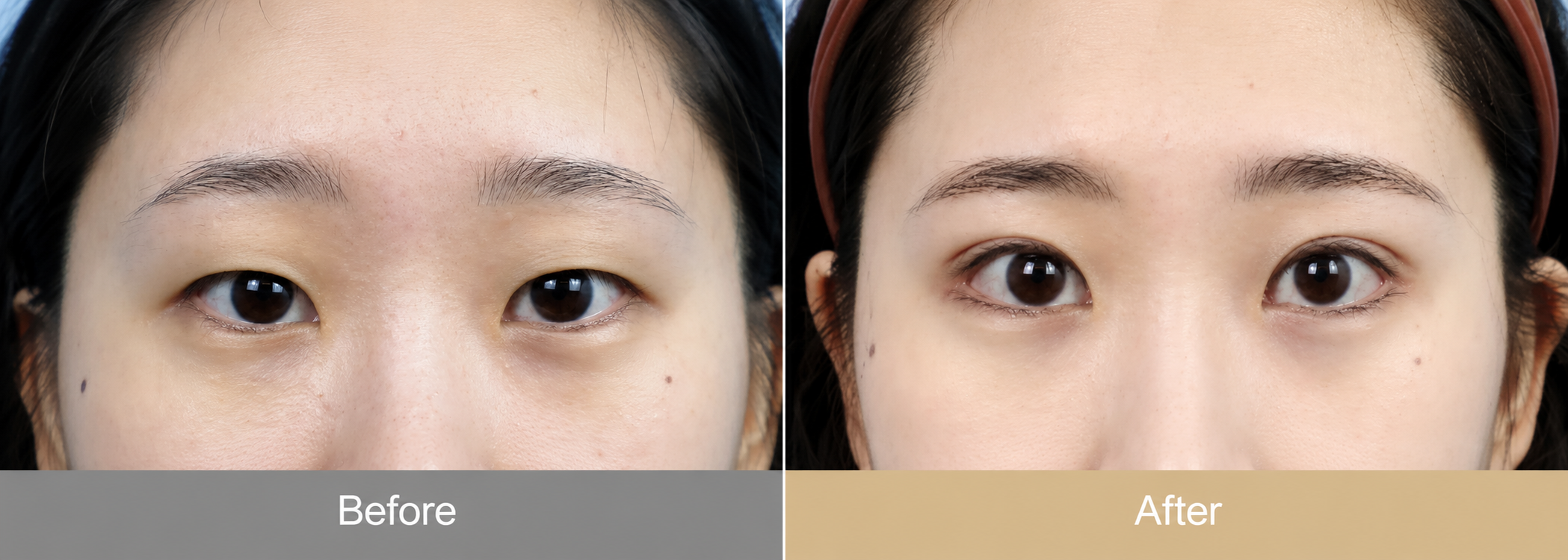
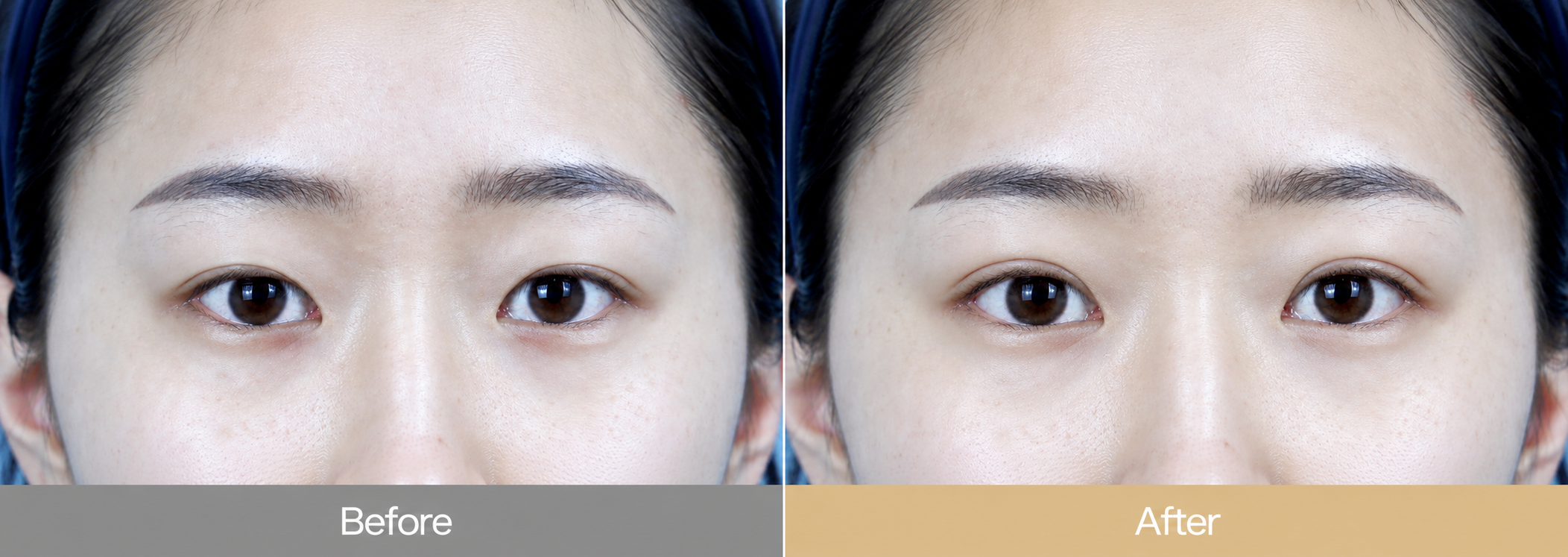
Before and after photographs can help patients understand the differences between eyelid crease designs and surgical approaches.
When reviewing double eyelid surgery results, consider:
- Eyelid crease height and shape
- Symmetry between both eyes
- How naturally the crease follows the eyelid contour
- The appearance of the eyes when fully open
- Whether the result complements the patient’s facial proportions
- How long after surgery the photographs were taken
A higher eyelid crease does not necessarily create a more attractive or natural-looking result.
For some patients, a lower and more subtle crease may be more appropriate.
It is also important to remember that early postoperative photographs may not represent the final result because swelling and tissue changes continue during healing.
Individual results vary, and before and after photographs should not be interpreted as a guarantee of similar outcomes.
Why Choose Signal Plastic Surgery for Double Eyelid Surgery in Busan?

Choosing a plastic surgeon is especially important for procedures involving the delicate structures of the eyelids.
Signal Plastic Surgery is led by Dr. Kyung Wook Nam, M.D., Ph.D., a board-certified plastic surgeon with experience as a former university hospital professor.
Eye surgery and revision eye surgery are key areas of focus at Signal Plastic Surgery.
The clinic provides a range of eyelid procedures, including:
- Incisional double eyelid surgery
- Non-incisional double eyelid surgery
- Ptosis correction
- Epicanthoplasty and lateral canthoplasty
- Under-eye fat repositioning
- Revision double eyelid surgery
- Selected eye-corner restoration procedures
Individualized Eyelid Assessment
Not every patient requesting double eyelid surgery has the same anatomical concerns.
During consultation, Dr. Nam evaluates factors such as eyelid skin thickness, excess skin, crease position, symmetry, and eyelid-opening function.
This assessment helps determine whether an incisional or non-incisional approach may be appropriate.
Experience With Revision Eye Surgery
Signal Plastic Surgery also evaluates patients who are dissatisfied with previous eyelid surgery.
Revision consultations may involve concerns about uneven creases, excessively high eyelid folds, scarring, or changes in eyelid shape.
Because previous surgery can alter tissue anatomy, revision procedures require careful planning.
This experience with complex eyelid concerns is particularly relevant when evaluating patients whose anatomy may not be suitable for a straightforward crease-formation procedure.
Support for International Patients
International patients considering Double Eyelid Surgery in Busan can receive assistance with:
- Pre-visit inquiries and appointment coordination
- Complimentary multilingual interpretation
- One-on-one consultation with a board-certified plastic surgeon
- Surgical planning and recovery information
- Postoperative care coordination and follow-up guidance
These patient support services are provided without a separate coordination fee. Applicable medical fees and treatment costs should be confirmed before booking.
Planning Double Eyelid Surgery in Korea as an International Patient
If you’re traveling to Korea specifically for double eyelid surgery, it’s important to consider both the operation and the follow-up schedule.
At Signal Plastic Surgery, patients generally receive postoperative care according to their procedure, with approximately two to three follow-up visits indicated in the clinic’s general guidance.
Before arranging flights, international patients should confirm:
- Whether incisional or non-incisional surgery is being considered
- Whether additional procedures may be necessary
- The expected postoperative appointment schedule
- Whether stitches will require removal
- How long they should remain in Busan
- When they may be medically fit to travel
An initial online inquiry can help patients prepare, but the final surgical recommendation requires an appropriate medical assessment.
Frequently Asked Questions About Double Eyelid Surgery in Korea
1. Is incisional or non-incisional double eyelid surgery better?
Neither method is universally better. Incisional surgery may be more appropriate for patients with thicker eyelids, excess skin, or more complex anatomical concerns. Non-incisional surgery may suit patients with thinner eyelids and minimal skin laxity. A plastic surgeon should assess which method is appropriate.
2. How much does double eyelid surgery cost in Busan?
At Signal Plastic Surgery, incisional double eyelid surgery is approximately KRW 1,650,000, while non-incisional double eyelid surgery is approximately KRW 1,155,000. Final pricing depends on the surgical plan and whether additional procedures are required.
3. Does non-incisional double eyelid surgery last forever?
Not necessarily. Although non-incisional techniques aim to create stable eyelid creases, the sutures or tissue connections may weaken over time. Longevity varies depending on eyelid anatomy, technique, and healing.
4. Will incisional double eyelid surgery leave a scar?
Yes. Incisional double eyelid surgery creates a scar along the planned incision. The scar may become less noticeable as it matures, but it is permanent. Scar appearance varies between patients.
5. How long does double eyelid surgery recovery take?
Signal Plastic Surgery provides a general recovery estimate of approximately one to two weeks. However, swelling and tissue changes may continue for several months, especially after incisional surgery.
6. Can double eyelid surgery fix sleepy-looking eyes?
Sometimes, but it depends on the cause. If the appearance is related to eyelid crease definition, double eyelid surgery may help. If the patient has true ptosis or weakness in eyelid-opening function, ptosis correction may be necessary.
7. Can I combine double eyelid surgery with ptosis correction?
Yes, selected patients may undergo double eyelid surgery and ptosis correction together. However, the need for combined surgery depends on eyelid-opening function and the surgeon’s assessment.
8. Can I choose the height and shape of my double eyelid crease?
Patients can discuss their preferred crease height and shape during consultation. However, the surgeon must consider eyelid anatomy, skin thickness, tissue tension, and facial proportions when determining what is realistically achievable.
9. Can I get double eyelid revision surgery at Signal Plastic Surgery?
Yes. Signal Plastic Surgery evaluates patients seeking revision after previous eyelid surgery, including concerns involving asymmetry, crease height, scarring, and unsatisfactory results. The possibility of revision depends on the patient’s anatomy and healing condition.
10. Does Signal Plastic Surgery provide English-speaking support?
Complimentary multilingual interpretation assistance can be arranged for international patients. Patients should confirm their preferred language and appointment requirements before visiting.
Considering Double Eyelid Surgery in Busan? Consult Signal Plastic Surgery
Choosing between incisional and non-incisional double eyelid surgery is not simply about selecting the technique with the shortest recovery time.
The most appropriate method depends on your eyelid anatomy, existing crease, skin thickness, eyelid-opening function, and personal goals.
At Signal Plastic Surgery in Busan, board-certified plastic surgeon Dr. Kyung Wook Nam provides individualized consultations for primary and revision eye surgery.
Whether you’re considering a subtle natural-looking crease, a more defined eyelid shape, or correction after previous surgery, the first step is understanding which approach may be suitable for you.
International patients can receive complimentary assistance with appointment coordination, multilingual interpretation, and postoperative care arrangements.
To request a consultation, please share:
- Your full name and nationality
- Your main eyelid concerns
- Whether you have undergone previous eye surgery
- Your preferred visit date
- Your expected stay in Korea
- Clear photographs of your eyes, if available
Contact Signal Plastic Surgery to discuss your options for Double Eyelid Surgery in Korea and arrange a personalized consultation in Busan.