Under-eye bags can make you look tired even when you have had enough rest. But what looks like a simple “eye bag” can actually be caused by different combinations of protruding fat, tear trough hollowing, skin laxity, and under-eye anatomy.
That is why Eye Bag Removal in Busan does not necessarily mean simply removing the fat beneath the eyes.
At Signal Plastic Surgery, under-eye surgery is planned after evaluating how much fat is present, where it is positioned, whether a hollow tear trough exists, and whether the fat should be removed, repositioned, or preserved.
For some patients, removing selected excess fat may be appropriate. For others, preserving and repositioning the existing fat can create a smoother transition between the lower eyelid and cheek.
- Eye Bag Removal Before & After
- What Actually Causes Under-Eye Bags?
- Eye Bag Removal vs Fat Repositioning
- Who May Consider Eye Bag Removal or Fat Repositioning?
- Eye Bag Removal in Busan: Surgery Information & Cost
- Does Eye Bag Removal Leave a Scar?
- Eye Bag Removal vs Lower Blepharoplasty
- Recovery After Eye Bag Removal
- Why Choose Signal Plastic Surgery for Eye Bag Removal in Busan?
- Frequently Asked Questions About Eye Bag Removal
- Considering Eye Bag Removal in Busan?
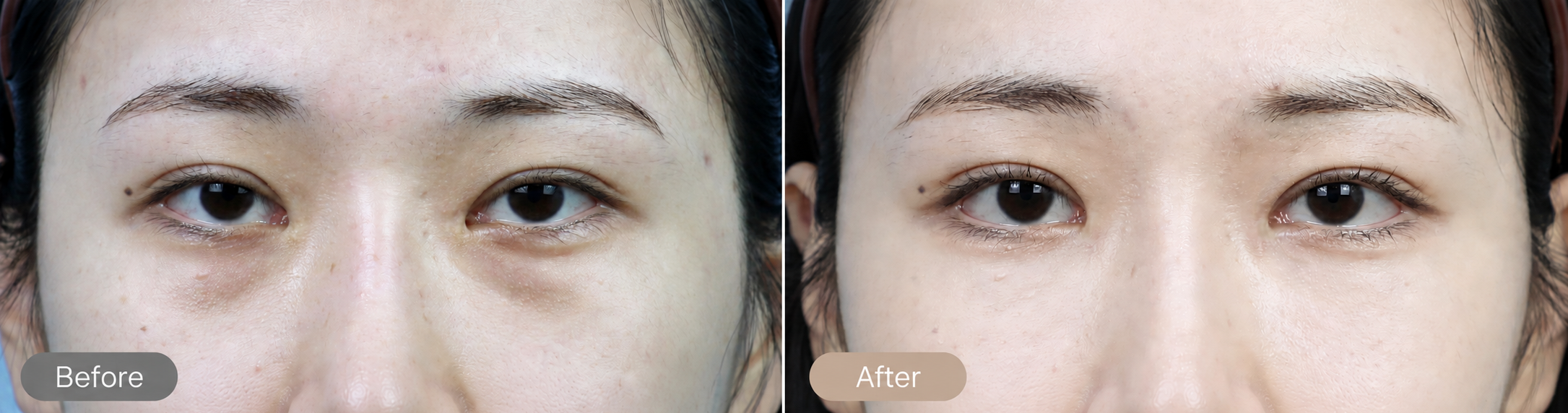
Eye Bag Removal Before & After
When looking at eye bag removal before and after photos, do not focus only on whether the bulge has disappeared.
A balanced result should also consider:
- Under-eye contour
- Transition between the lower eyelid and cheek
- Tear trough hollowing
- Remaining under-eye volume
- Symmetry
- Overall facial balance
The goal is not necessarily to make the under-eye area completely flat.
Removing too much volume can create or worsen a hollow appearance, which is why determining how the existing fat should be managed is important.
What Actually Causes Under-Eye Bags?
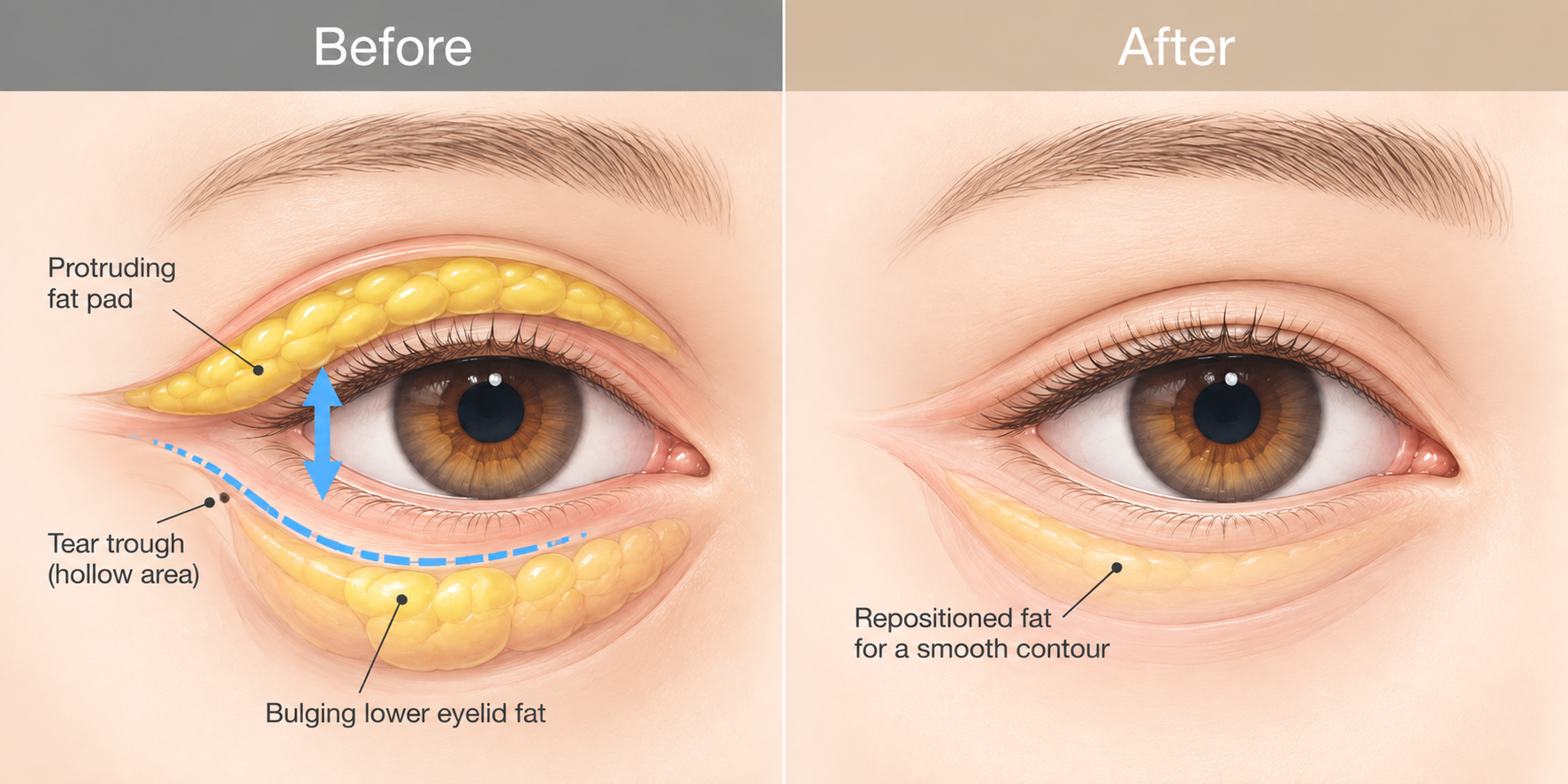
Under-eye bags commonly become visible when the fat beneath the lower eyelid protrudes forward.
However, the appearance can become more noticeable when a tear trough hollow sits directly below the protruding fat.
This creates two contrasting contours:
Bulging above + hollowing below
The difference in height can create a stronger shadow, making the under-eye area appear heavier, darker, or more tired.
This is why two people who both describe their concern as “eye bags” may require different surgical plans.

Eye Bag Removal vs Fat Repositioning
This is one of the most important distinctions when considering under-eye surgery.
Simply removing protruding fat can reduce excess fullness. But if a hollow area already exists beneath the fat, removing too much volume may make the under-eye area appear flatter or more hollow.
Lower eyelid fat repositioning takes a different approach.
Instead of automatically removing the protruding fat, appropriate fat can be preserved and repositioned toward the tear trough to create a smoother contour.
Do I Need Fat Removal?
| Fat Removal May Be Considered | Surgery Without Significant Fat Removal May Be Considered | |
|---|---|---|
| Main Concern | Excessive or localized fat bulging | Bulging combined with tear trough hollowing |
| Under-Eye Volume | More excess volume is present | Existing volume may be useful for contour correction |
| Tear Trough | Minimal hollowing | More noticeable hollowing |
| Treatment Goal | Reduce selected excess fullness | Preserve and redistribute volume |
| Fat Management | Selected fat may be removed | Fat may be repositioned rather than removed |
| Main Consideration | Avoid unnecessary residual bulging | Avoid creating or worsening hollowing |
This is not a decision that should be made based on a photo or age alone.
The surgeon needs to evaluate the amount and position of fat, tear trough depth, lower-eyelid support, skin condition, and the relationship between the lower eyelid and cheek.
Who May Consider Eye Bag Removal or Fat Repositioning?
Under-eye surgery may be considered if you:
- Have noticeable under-eye bags
- Look tired because of protruding lower-eyelid fat
- Have both an under-eye bulge and tear trough hollow
- Notice shadows beneath the eyes caused by uneven contour
- Want a smoother transition between the lower eyelid and cheek
- Feel that your under-eye contour makes you look older or more tired
- Have persistent eye bags that do not improve with skincare
However, not every dark circle or tired-looking under-eye area is caused by fat.
Pigmentation, thin skin, visible blood vessels, skin laxity, and other factors may also contribute, so identifying the actual cause is important before deciding on surgery.
Eye Bag Removal in Busan: Surgery Information & Cost
| Surgery Information | Details |
|---|---|
| Procedure | Lower Eyelid Fat Repositioning / Eye Bag Surgery |
| Surgery Time | Approximately 30 minutes |
| Anesthesia | Sedation + Local Anesthesia |
| Hospitalization | Not required |
| Discharge | Same day |
| Return to Daily Activities | Possible immediately, depending on individual swelling and bruising |
| Routine Follow-Up Treatment | Not required unless advised |
| Price | KRW 2,145,000 |
The final price may vary if additional procedures or corrections are required.
A consultation is therefore necessary to determine whether fat removal, fat repositioning, or another approach is more appropriate for your under-eye anatomy.
Does Eye Bag Removal Leave a Scar?
When lower eyelid fat repositioning is performed through a transconjunctival approach, the fat is accessed from inside the lower eyelid.
This means there is no external skin incision for the fat repositioning itself.
However, this approach does not remove loose external skin.
If significant skin laxity or under-eye wrinkles are also present, a different surgical approach such as lower blepharoplasty may be considered.
This distinction is especially important when comparing eye bag surgery options.
Eye Bag Removal vs Lower Blepharoplasty
Fat repositioning and lower blepharoplasty are not always interchangeable.
Lower Eyelid Fat Repositioning : More focused on protruding fat and tear trough hollowing, particularly when significant excess skin is not the main concern.
Lower Blepharoplasty : May be more appropriate when under-eye bags are accompanied by noticeable loose skin and wrinkles that also need correction.
Age can provide some context, but it should not determine the surgery by itself.
A younger patient can have significant skin laxity, while an older patient may retain relatively good skin elasticity.
The choice should therefore be based on anatomy rather than age alone.
Recovery After Eye Bag Removal
Although the procedure is relatively short and does not require hospitalization, some swelling or bruising should still be expected.
Temporary symptoms may include:
- Swelling
- Bruising
- Tenderness
- Tightness around the lower eyelids
- Temporary dryness or irritation
Patients may be able to return to normal daily activities relatively quickly, but this does not mean that the under-eye area will immediately look completely recovered.
The final contour becomes easier to evaluate as swelling gradually subsides.
International patients should also consider their travel and photography schedule when choosing a surgery date.
Why Choose Signal Plastic Surgery for Eye Bag Removal in Busan?
The key question in eye bag surgery is not simply:
“How much fat can be removed?”
It is:
“Which fat should be removed, preserved, or repositioned to create the most appropriate contour for this face?”
Signal Plastic Surgery is led by a board-certified plastic surgeon with an M.D. and Ph.D. and experience as a former university hospital professor.
Before surgery, the surgeon evaluates:
- Amount and position of under-eye fat
- Tear trough depth
- Existing under-eye hollowing
- Lower-eyelid support
- Skin condition
- Facial symmetry
- Previous eyelid procedures
- Balance between the lower eyelid and cheek
Signal Plastic Surgery also has extensive experience in eyelid and revision surgery, which is particularly relevant when planning delicate changes around the lower eyelid.
International patients can receive pre-visit consultation assistance and medical interpretation support when planning surgery in Busan.
Frequently Asked Questions About Eye Bag Removal
Should under-eye fat always be removed?
No.
Some patients have excess fat that may benefit from selective removal, while others have a combination of protruding fat and tear trough hollowing. In those cases, preserving and repositioning appropriate fat may help create a smoother contour.
What is the difference between eye bag removal and fat repositioning?
Eye bag removal generally refers to reducing excess under-eye fat, while fat repositioning preserves appropriate fat and moves it toward a hollow area such as the tear trough.
The exact technique depends on the patient’s anatomy.
Can removing under-eye fat make my eyes look hollow?
Removing too much volume may contribute to an unwanted hollow appearance, particularly when tear trough hollowing already exists.
This is why the amount of fat that should be removed, preserved, or repositioned needs to be evaluated individually.
How much does Eye Bag Removal in Busan cost?
At Signal Plastic Surgery, lower eyelid fat repositioning is KRW 2,145,000.
The final cost may differ if additional procedures or corrections are required.
Will eye bag removal improve my dark circles?
It may improve shadows caused by protruding fat and uneven under-eye contours.
However, dark circles can also result from pigmentation, thin skin, visible blood vessels, and other causes, so eye bag surgery does not correct every type of dark circle.
Is eye bag removal the same as lower blepharoplasty?
Not necessarily.
Lower blepharoplasty is a broader lower-eyelid surgery that may involve skin removal as well as management of fat. Fat repositioning may be performed through the inside of the lower eyelid when significant skin removal is not required.
Will there be a visible scar after under-eye fat repositioning?
With a transconjunctival approach, the surgical access is made from inside the lower eyelid, so there is no external skin incision for the fat repositioning itself.
If skin removal is also required, the surgical approach may be different.
How long does eye bag removal surgery take?
At Signal Plastic Surgery, lower eyelid fat repositioning takes approximately 30 minutes, although the exact duration can vary depending on the surgical plan.
Can I return to normal activities after surgery?
Same-day discharge is possible, and patients may return to daily activities relatively quickly.
However, swelling and bruising can still be visible, so patients should distinguish between being able to resume daily activities and being fully recovered aesthetically.
How do I know whether I need fat removal or fat repositioning?
The decision depends on the amount of protruding fat, existing hollowing, tear trough depth, skin condition, and lower-eyelid anatomy.
A surgical consultation is necessary to determine whether fat should be removed, repositioned, preserved, or managed using a combination of techniques.
Considering Eye Bag Removal in Busan?
If you are researching Eye Bag Removal in Korea, do not assume that every under-eye bag needs the same surgery.
For one patient, removing selected excess fat may be appropriate.
For another, preserving and repositioning the fat may create a more balanced result.
And when significant loose skin and wrinkles are also present, lower blepharoplasty may need to be considered instead.
At Signal Plastic Surgery, the surgical plan is determined after evaluating the fat, hollowing, skin, lower-eyelid support, and overall under-eye contour rather than simply removing as much fat as possible.
For international patients considering Eye Bag Removal in Busan, pre-visit consultation can help determine which under-eye surgery may be appropriate before traveling to the clinic.