If you are researching lifting treatments in Korea, Ulthera, Thermage FLX, and InMode are three names you are likely to encounter.
Although all three are used in non-surgical aesthetic treatment, they use different technologies and are not designed to address exactly the same concerns.
At Signal Plastic Surgery, Non-Surgical Face Lifting in Busan begins with identifying what is contributing to the change you see — such as tissue laxity, reduced skin firmness, or facial fullness — before choosing a device.
So, how do Ulthera, Thermage, and InMode actually differ?
- Ulthera vs Thermage vs InMode: What’s the Difference?
- Ulthera: Focused Ultrasound for Lifting
- Thermage FLX: RF for Skin Tightening and Firmness
- InMode: RF-Based Facial Contouring and Tightening
- Which Treatment Is Right for Your Concern?
- HIFU vs RF: Why the Technology Matters
- What If You Have a Thin Face?
- Why Choose Signal Plastic Surgery for Non-Surgical Face Lifting?
- Frequently Asked Questions About Non-Surgical Face Lifting
- Considering Non-Surgical Face Lifting in Busan?
Ulthera vs Thermage vs InMode: What’s the Difference?
The simplest way to compare these treatments is by looking at their technology and treatment goals.
| Ulthera | Thermage FLX | InMode | |
|---|---|---|---|
| Technology | Microfocused ultrasound | Monopolar radiofrequency (RF) | RF-based platform |
| Main Focus | Targeted lifting at specific tissue depths | Skin tightening & firmness | Depends on the handpiece; may include tightening or facial contouring |
| Often Considered For | Jawline, lower face, under-chin or brow laxity | Skin laxity, reduced firmness, wrinkles | Lower-face contour, fullness or skin tightening depending on treatment |
| Key Feature | Real-time ultrasound visualization | Controlled RF heating | Multiple RF technologies and handpieces |
| Price at Signal | KRW 500,000 range per 100 shots | Mid-KRW 3 million range / 600 shots | KRW 500,000 range |
Prices are general references and may vary according to the treatment area and individualized treatment plan.
The key point is that these devices should not be compared only by price or popularity. The right treatment depends on what you actually want to improve.

Ulthera : Focused Ultrasound for Lifting
Ulthera uses microfocused ultrasound with real-time visualization to deliver energy at specific tissue depths.
Its transducers can target 1.5 mm, 3.0 mm, and 4.5 mm, allowing treatment to be planned across different collagen-rich tissue layers. The real-time imaging system allows the provider to visualize tissue and select the appropriate treatment depth.
Ulthera may be considered when concerns include:
- A less-defined jawline
- Lower-face laxity
- Sagging beneath the chin
- Brow laxity
- Loss of definition related to tissue laxity
Rather than producing the immediate repositioning associated with surgery, Ulthera works through a gradual collagen-remodeling response. The manufacturer also specifically notes that it does not duplicate the results of a surgical facelift.
At Signal Plastic Surgery, Ulthera is generally in the KRW 500,000 range per 100 shots.
The number of shots should be planned according to facial anatomy and the treatment area rather than assuming that a higher shot count is always better.
Thermage FLX : RF for Skin Tightening and Firmness
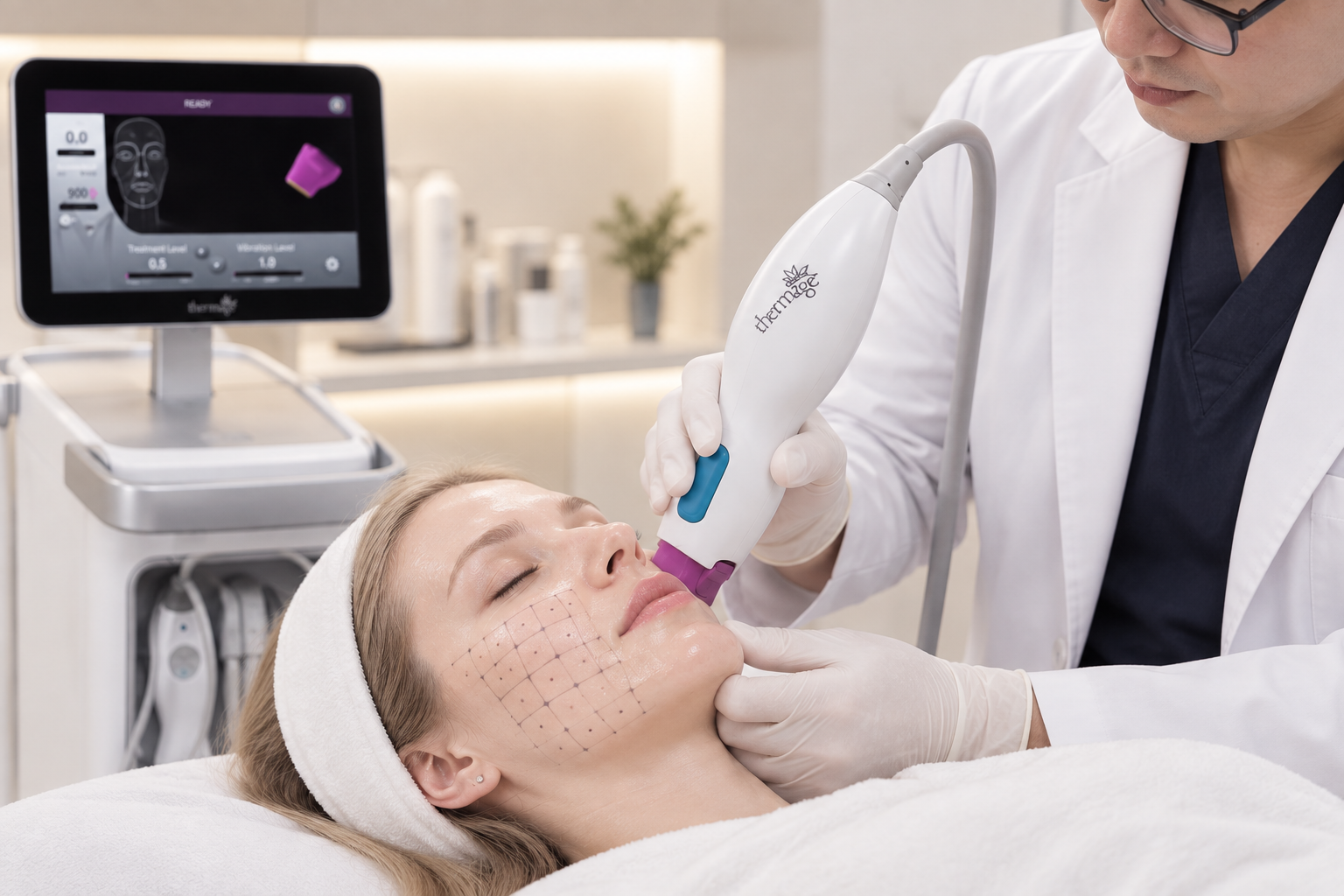
Thermage FLX uses monopolar radiofrequency energy to deliver controlled heating into tissue.
It is commonly considered when the treatment goal is related to skin tightening, firmness, and the appearance of wrinkles rather than primarily targeting deeper lifting.
Thermage FLX may be considered for:
- Reduced skin firmness
- Mild skin laxity
- Fine lines and wrinkles
- Early signs of skin aging
- Patients seeking overall skin tightening
The Thermage FLX system uses different treatment tips according to the treatment area, including Total Tips for broader treatment areas and an Eye Tip designed for the periorbital area.
At Signal Plastic Surgery, Thermage FLX 600 shots is generally in the mid-KRW 3 million range.
This is why asking whether Ulthera or Thermage is simply “better” can be misleading. Their technologies and treatment goals differ.
InMode : RF-Based Facial Contouring and Tightening
InMode is different from Ulthera and Thermage because InMode refers to a platform that includes multiple technologies and treatment options rather than one single facial treatment.
Its portfolio includes different forms of RF technology, including bipolar RF and other RF-based approaches. The effect and treatment depth therefore depend on the specific handpiece or technology being used.
Depending on the treatment plan, InMode may be considered for concerns such as:
- Lower-face fullness
- Facial contour definition
- Mild skin laxity
- Jawline definition
- Skin tightening
At Signal Plastic Surgery, InMode treatment is generally in the KRW 500,000 range.
If you are comparing InMode treatments in Korea, it is useful to ask which handpiece or treatment mode is being recommended and why, rather than comparing clinics based only on the name “InMode.”
Which Treatment Is Right for Your Concern?
There is no single lifting device that is best for every face.
A useful starting point is to identify your main concern.
My jawline looks less defined or my lower face is beginning to sag.
Ulthera may be considered when targeted lifting at specific tissue depths is the priority.
My skin feels less firm and I am noticing laxity or fine lines.
Thermage FLX may be considered when overall skin tightening and firmness are the main goals.
My lower face looks full and I want more contour definition.
An appropriate InMode treatment may be considered when facial contouring is part of the treatment goal.
These are simplified examples rather than fixed treatment rules. Facial aging can involve the skin, fat distribution, deeper supporting tissues, and volume changes at the same time.
HIFU vs RF: Why the Technology Matters
Another common way to compare Korean lifting treatments is ultrasound vs radiofrequency.
Ulthera — Microfocused Ultrasound
Ulthera delivers focused ultrasound energy at predetermined depths and uses real-time visualization during treatment.
Thermage FLX — Monopolar RF
Thermage uses radiofrequency energy and controlled tissue heating, with treatment focused on tightening and improving the appearance of wrinkles.
InMode — Multiple RF Technologies
InMode’s portfolio includes different RF modalities, so the purpose and tissue interaction depend on the specific technology or handpiece being used.
For patients researching Non-Surgical Face Lifting in Korea, this distinction is more useful than simply asking which machine is stronger.
What If You Have a Thin Face?
Patients with naturally slim faces often worry about looking more hollow after lifting treatments.
If you already have noticeable volume loss around the cheeks, temples, or under-eye area, this should be discussed during consultation before selecting an energy-based treatment.
Treatment planning may consider:
- Facial fat distribution
- Existing areas of volume loss
- Skin thickness
- Location and degree of laxity
- Treatment area and depth
- The specific device or handpiece being used
Energy-based lifting treatments are not treatments for restoring lost facial volume.
For a thin face, the goal should therefore be to identify where lifting or tightening is actually needed without treating every area in the same way.
Why Choose Signal Plastic Surgery for Non-Surgical Face Lifting?
Choosing a lifting treatment should involve more than selecting a machine from a treatment menu.
Signal Plastic Surgery is led by a board-certified plastic surgeon with an M.D. and Ph.D. and experience as a former university hospital professor.
Facial aging can involve different anatomical layers and changes in skin quality, tissue support, fat distribution, and facial volume.
For this reason, treatment planning at Signal focuses first on what is creating the patient’s concern before deciding whether ultrasound lifting, RF tightening, facial contouring, or another approach should be considered.
The goal is not simply to recommend the highest number of shots or the most expensive device, but to select a treatment appropriate for the patient’s facial anatomy and goals.
International patients can also receive pre-visit consultation assistance and medical interpretation support when planning treatment in Busan.
Frequently Asked Questions About Non-Surgical Face Lifting
Which is better : Ulthera or Thermage?
Neither treatment is universally better.
Ulthera uses microfocused ultrasound with real-time visualization and can target specific tissue depths. Thermage FLX uses monopolar RF and is commonly considered for skin tightening, firmness, and wrinkles.
The better option depends on your facial anatomy and primary concern.
Is Ulthera good for a thin face?
It can be appropriate for selected patients, but a thin face requires careful treatment planning.
If you already have facial hollowing or limited facial volume, tell your doctor before treatment so that your fat distribution, treatment areas, and tissue depths can be considered.
Can Ulthera or InMode cause facial fat loss?
The answer depends on the technology, treatment area, treatment depth, settings, and—in the case of InMode—the specific handpiece being used.
If preserving facial volume is important to you, discuss this before treatment rather than selecting a device based only on its lifting or contouring reputation.
Is Thermage better if I don’t want to lose facial volume?
Thermage FLX is primarily used as a non-invasive RF treatment for skin tightening and wrinkles rather than being selected specifically as a facial fat-reduction treatment.
However, treatment should still be individualized according to skin thickness, laxity, facial anatomy, and volume distribution.
How painful are Ulthera, Thermage and InMode?
Treatment sensation varies between devices, treatment areas, settings, and individuals.
Ultrasound treatments and RF treatments can feel different, and pain-management methods may also vary. Ask about the expected sensation and available comfort measures before treatment.
How much does Non-Surgical Face Lifting in Busan cost?
At Signal Plastic Surgery, Ulthera is generally in the KRW 500,000 range per 100 shots, Thermage FLX 600 shots is in the mid-KRW 3 million range, and InMode is generally in the KRW 500,000 range.
Final pricing varies according to the device, treatment area, number of shots, handpiece, and individualized treatment plan.
Do I need Ulthera and Thermage together?
Not necessarily.
Because they use different technologies, combining them may be considered when a patient has more than one treatment concern. However, if one treatment appropriately addresses your main concern, adding another device simply because it is popular may not be necessary.
How soon will I see results?
The timing varies by device and individual response.
Treatments that stimulate collagen remodeling generally develop their effects progressively rather than producing the immediate tissue repositioning associated with surgery.
Is there downtime after Ulthera, Thermage or InMode?
These treatments generally involve less recovery than surgery, but temporary reactions such as redness, swelling, tenderness, or heat sensation can occur.
Expected downtime depends on the device, treatment area, settings, and specific InMode treatment being performed.
Can non-surgical lifting replace a facelift?
No. Non-surgical lifting and tightening treatments do not reproduce the degree of tissue repositioning possible with facelift surgery.
They may be considered for selected patients with appropriate laxity or skin-tightening concerns, while more advanced sagging may require a different approach.
Considering Non-Surgical Face Lifting in Busan?
Instead of asking:
“Which lifting machine is the strongest?”
A better starting point is:
“What is actually causing the change in my face?”
Deeper tissue laxity, reduced skin firmness, facial fullness, and volume loss are different concerns and may require different approaches.
At Signal Plastic Surgery, Ulthera, Thermage FLX, and InMode are considered according to facial anatomy, tissue condition, previous treatments, and the patient’s goals.
For international patients considering Non-Surgical Face Lifting in Korea, consultation can help determine whether ultrasound lifting, RF tightening, facial contouring, or a carefully selected combination is appropriate.