When the outer and lower corners of the eyes appear relatively closed, the eyes can look shorter, narrower, or less open than desired.
At Signal Plastic Surgery, Lateral Canthoplasty in Busan can be planned together with lower canthoplasty to adjust both the horizontal and lower direction of the eye opening. Signal calls this combined approach Charming Canthoplasty.
Rather than simply trying to make the eyes look bigger, the goal is to create a more open eye shape while considering the patient’s existing anatomy, outer-corner angle, eye proportions, and desired degree of change.
For international patients considering Lateral Canthoplasty in Korea, understanding whether lateral canthoplasty alone or a combined lateral and lower approach is appropriate is an important part of surgical planning.
- What Is Lateral Canthoplasty?
- Lateral Canthoplasty in Busan: Non-Incisional vs Incisional
- What Is Signal Charming Canthoplasty?
- Who May Consider Lateral or Charming Canthoplasty?
- How Is Lateral Canthoplasty Performed?
- What to Expect From Lateral Canthoplasty at Signal Plastic Surgery
- Why Fixation Matters in Lateral Canthoplasty
- Before & After Lateral Canthoplasty
- Why Choose Signal Plastic Surgery for Lateral Canthoplasty?
- Frequently Asked Questions About Lateral Canthoplasty
What Is Lateral Canthoplasty?
Lateral canthoplasty is an eye surgery that adjusts the outer corner of the eye.
It may be considered when the horizontal eye opening appears relatively short or when an upturned or closed outer corner contributes to a narrower-looking eye shape.
At Signal Plastic Surgery, lateral canthoplasty may also be combined with lower canthoplasty when opening only the outer corner would not sufficiently address the patient’s eye shape.
This combined lateral and lower approach is called Charming Canthoplasty at Signal Plastic Surgery.
By adjusting both directions together, the surgical plan can consider not only horizontal length but also the shape and balance of the outer and lower eye.

Lateral Canthoplasty in Busan: Non-Incisional vs Incisional
Signal Plastic Surgery considers both non-incisional and incisional approaches depending on the patient’s anatomy and desired degree of change.
| Method | May Be Considered When |
|---|---|
| Non-Incisional Canthoplasty | Faster recovery is important and the patient wants a subtle, natural change |
| Incisional Canthoplasty | The outer corners are noticeably upturned or the horizontal eye length is relatively short, creating a closed or narrow appearance |
Neither method is automatically better.
The appropriate approach depends on the existing outer-corner position, eye length, surrounding tissues, and the amount of change that can be achieved safely.
What Is Signal Charming Canthoplasty?
Some patients do not need change in only one direction.
If the outer corner is relatively closed while the lower outer portion of the eye also contributes to a narrow or upturned appearance, lateral canthoplasty and lower canthoplasty can be performed together.
Signal Plastic Surgery refers to this combined approach as Charming Canthoplasty.
The purpose is to consider the eye in two directions:
Lateral Canthoplasty : Adjusts the outer corner to address horizontal eye length and outer-corner shape.
Lower Canthoplasty : Adjusts the lower outer direction of the eye according to the patient’s anatomy and desired eye contour.
Performing both does not mean that the eye should be opened as much as possible.
The degree and direction of correction need to remain within a range that maintains natural eye proportions and appropriate eyelid support.
Who May Consider Lateral or Charming Canthoplasty?
Lateral canthoplasty may be considered for patients who:
- Have relatively short horizontal eye length
- Feel that the outer corners make their eyes look closed or narrow
- Have noticeably upturned outer eye corners
- Want a more open-looking eye shape
- Prefer a subtle change with relatively fast recovery
- May benefit from adjustment in both the lateral and lower directions
The amount of achievable change varies because the surrounding bone structure, eyelid support, outer-corner anatomy, and existing eye shape differ from person to person.
How Is Lateral Canthoplasty Performed?
Signal Plastic Surgery’s incisional lateral canthoplasty generally involves three main steps.
STEP 01 — V-Shaped Incision
A V-shaped incision is made around the lateral canthal area according to the planned outer-corner position.
STEP 02 — Repositioning and Fixation
The lateral canthal ligament and surrounding tissues are adjusted and secured to the periosteum near the outer orbital area to support the planned position.
STEP 03 — Closure
The incision is carefully closed after the outer-corner position and overall eye shape have been assessed.
The exact surgical plan may vary depending on individual anatomy and whether lower canthoplasty is performed at the same time.
What to Expect From Lateral Canthoplasty at Signal Plastic Surgery
The surgical method is selected according to the patient’s eye anatomy, outer-corner position, desired degree of change, and whether an incisional or non-incisional approach is appropriate.
| Surgery Information | General Guide |
|---|---|
| Surgery Time | Approximately 30–40 minutes |
| Anesthesia | Local anesthesia |
| Suture Removal | Non-incisional: No suture removal / Incisional: Approximately 7 days |
| Recovery | Non-incisional: Immediate return to daily activities / Incisional: Approximately 1–2 weeks |
| Price | Approximately KRW 2.4–2.9 million |
The cost of lateral canthoplasty at Signal Plastic Surgery generally ranges from the mid to high KRW 2 million range, depending on whether a non-incisional or incisional technique is used and the individual surgical plan.
These are general clinic guidelines. The appropriate surgical method, final cost, and recovery period may vary according to individual anatomy and the treatment plan determined during consultation.
Why Fixation Matters in Lateral Canthoplasty
One of the most common concerns patients have about lateral canthoplasty is whether the outer corner can reattach or partially return toward its previous position during healing.
This concern also appears frequently in English-language discussions and patient research about canthoplasty.
For an incisional procedure, simply opening the outer corner is not the only consideration. The repositioned tissues also need appropriate support and fixation.
At Signal Plastic Surgery, the surgical process includes fixation of the lateral canthal structures to the periosteum according to the planned position.
However, no surgical technique can guarantee that the eye corner will never change during healing. Scar formation, tissue response, anatomy, and the degree of correction can all affect the long-term result.
Before & After Lateral Canthoplasty
Before-and-after photographs can help demonstrate how lateral canthoplasty may change the outer eye contour and overall impression.
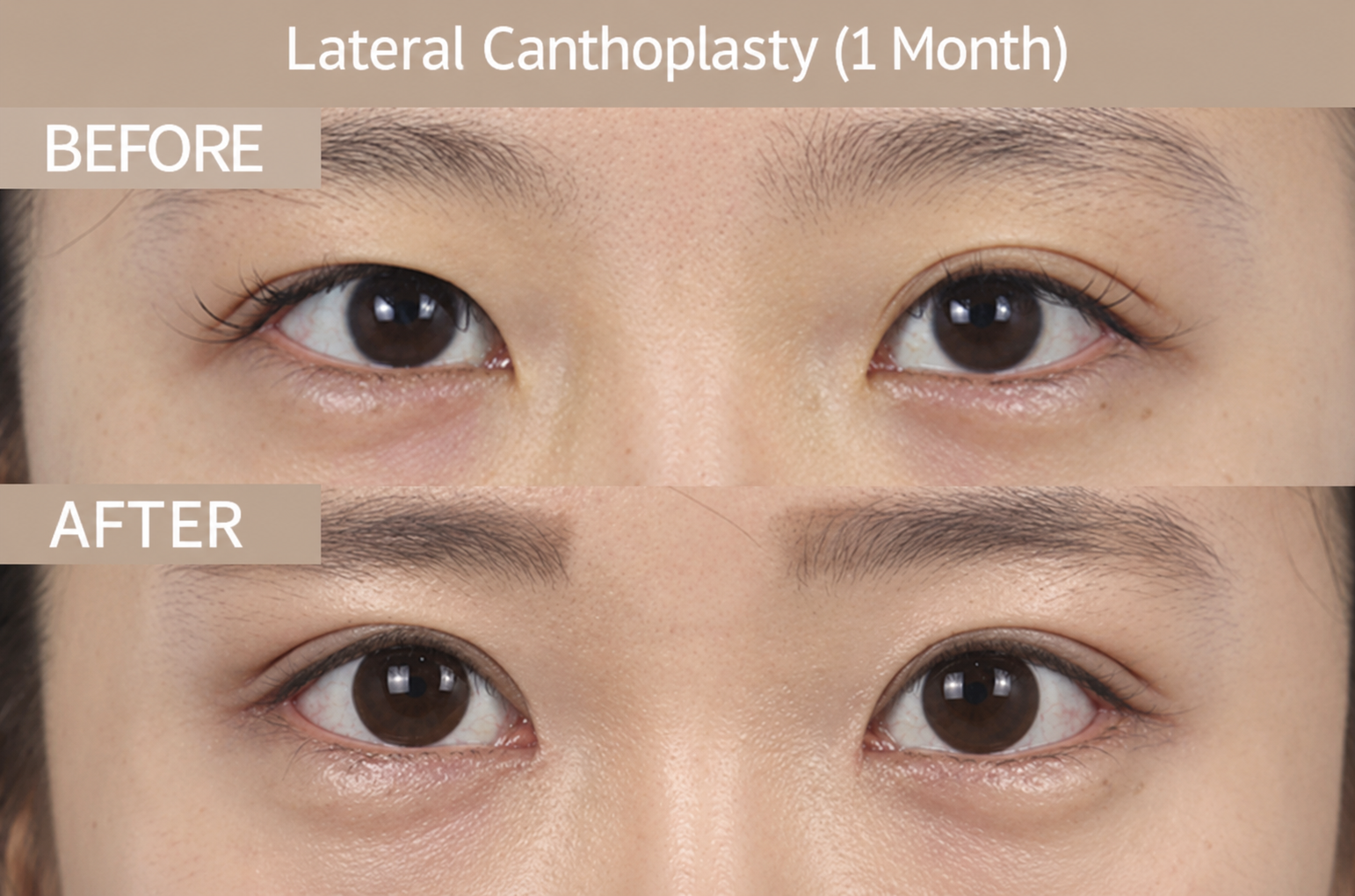
When reviewing before-and-after photographs, pay attention not only to how much larger the eyes appear but also to:
- Outer-corner position
- Horizontal eye length
- Lower outer-eye contour
- Left-right balance
- Overall harmony with the face
Individual results vary according to anatomy, surgical method, and healing response.
Why Choose Signal Plastic Surgery for Lateral Canthoplasty?
Canthoplasty is a relatively small-area eye surgery, but even a few millimeters of change can affect the overall eye shape.
This makes surgical planning particularly important.
At Signal Plastic Surgery, the surgeon evaluates:
- Existing eye length
- Outer-corner angle
- Degree of upward slant
- Lower eyelid contour
- Left-right symmetry
- Surrounding tissue condition
- Desired degree of change
Signal Plastic Surgery is led by a board-certified plastic surgeon with an M.D. and Ph.D. and experience as a former university hospital professor.
The clinic also has particular experience with eye surgery and revision eye surgery, allowing the surgical plan to consider not only how much the eye can be opened, but how the change fits the patient’s existing anatomy.
Frequently Asked Questions About Lateral Canthoplasty
Can lateral canthoplasty reattach or return to its original position?
Some degree of change or partial recurrence can occur during healing.
This is one of the most frequently discussed concerns among patients researching lateral canthoplasty. Scar contraction, tissue healing, anatomy, surgical technique, and fixation can all influence the long-term position.
The goal of fixation is to support the repositioned tissues, but no technique can guarantee zero recurrence.
Should lateral and lower canthoplasty be done together?
Not always.
Lateral canthoplasty primarily addresses the outer direction, while lower canthoplasty addresses the lower outer contour.
Some patients may need only lateral adjustment, while others may benefit from changing both directions to create a more balanced eye shape.
At Signal Plastic Surgery, the combined approach is called Charming Canthoplasty.
Will lateral canthoplasty leave a visible scar?
An incisional lateral canthoplasty requires an incision, so scar formation is part of the healing process.
Early redness or a visible incision line may gradually improve as the scar matures. The final appearance varies according to incision placement, skin characteristics, surgical technique, and individual healing.
Patients particularly concerned about scarring should discuss whether a non-incisional or incisional approach is more appropriate for their anatomy.
Will my eyes look unnaturally wide after lateral canthoplasty?
The goal should not be to open the outer corner as far as possible.
The amount of correction is limited by the patient’s anatomy and the need to maintain appropriate eye shape and eyelid support.
At Signal Plastic Surgery, the planned change is considered in relation to the existing eye length, outer-corner angle, lower eyelid contour, and overall facial proportions.
How long does recovery take after lateral canthoplasty?
Recovery depends on the surgical method.
According to Signal Plastic Surgery’s general guidelines, patients undergoing a non-incisional approach may return to normal daily activities immediately, while initial recovery after an incisional procedure is approximately 1–2 weeks.
For incisional surgery, sutures are generally removed at approximately 7 days.
Swelling, redness, and subtle changes in eye shape may continue beyond the initial recovery period.
Can lateral canthoplasty cause dry eyes?
Temporary dryness, irritation, or sensitivity can occur after surgery around the eye.
Dry-eye concerns are also discussed by patients who have undergone combinations of lateral and lower canthoplasty.
Patients with existing dry eye, difficulty closing the eyes, previous eyelid surgery, or other eye conditions should inform the surgeon before surgery so that these factors can be considered during evaluation.
Can I combine lateral canthoplasty with double eyelid surgery or ptosis correction?
Combination surgery may be possible depending on the patient’s anatomy and goals.
Double eyelid surgery primarily changes the eyelid crease, ptosis correction addresses eyelid-opening strength, and lateral canthoplasty changes the outer eye contour.
Performing multiple procedures together may allow different aspects of the eye shape to be addressed in one surgical plan, but not every patient needs every procedure.
Is non-incisional lateral canthoplasty better than incisional surgery?
Neither approach is universally better.
A non-incisional approach may be considered when a patient wants a subtle change and faster recovery.
An incisional approach may be more appropriate when the outer corner is noticeably upturned or the horizontal eye opening is relatively short and greater structural adjustment is required.
The appropriate method should be determined after examining the patient’s eye anatomy.
Considering Lateral Canthoplasty at Signal Plastic Surgery in Busan?
If your eyes appear short, narrow, or more upturned at the outer corners than you prefer, the question is not simply:
“How much can my eyes be enlarged?”
A more useful question is:
“Which direction and degree of change would best fit my existing eye shape?”
At Signal Plastic Surgery, lateral canthoplasty can be planned alone or together with lower canthoplasty as Charming Canthoplasty, depending on the patient’s outer-corner position, lower eyelid contour, eye proportions, and desired result.
For international patients considering Lateral Canthoplasty in Busan, consultation can help determine whether a non-incisional, incisional, or combined lateral and lower approach is appropriate.