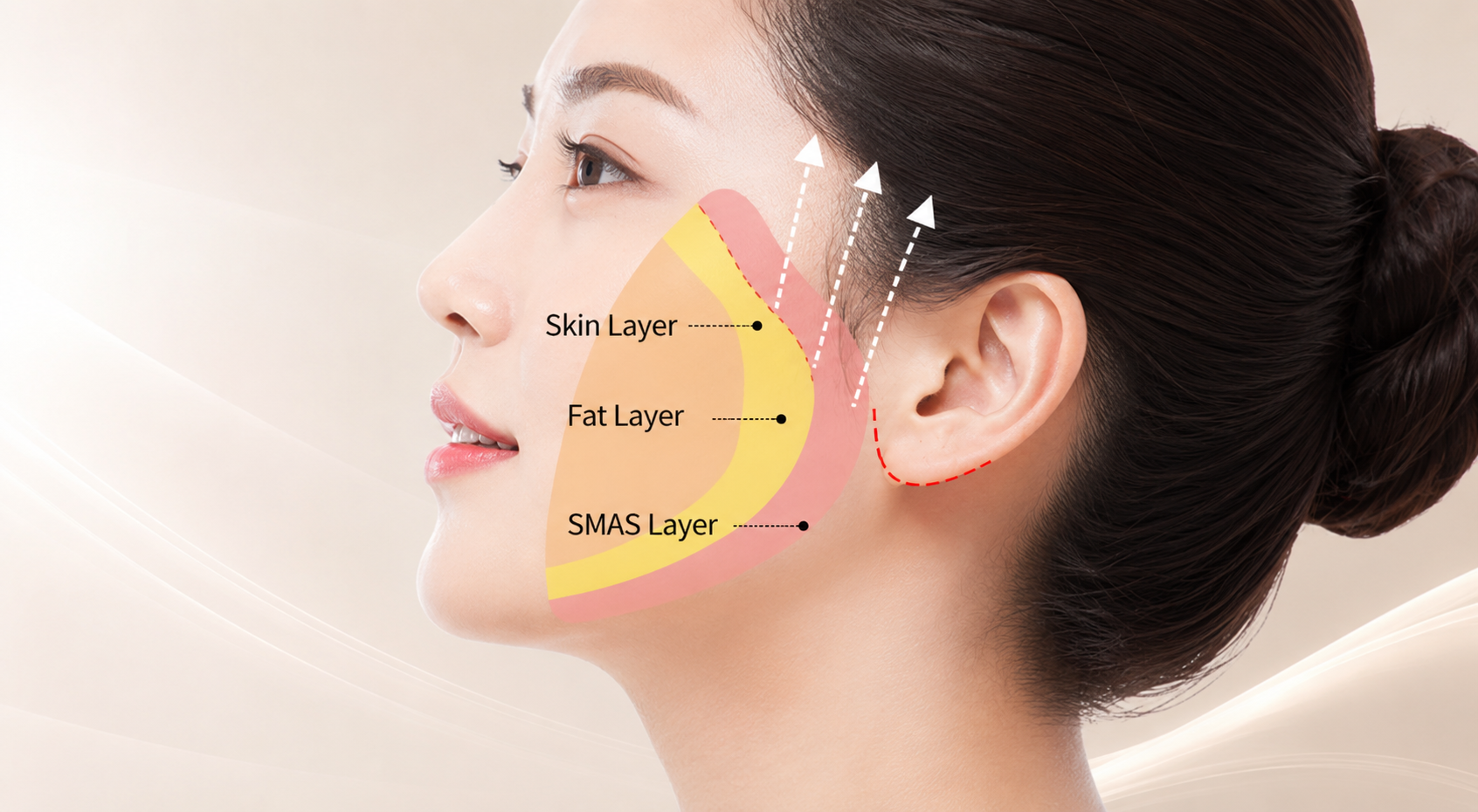
Facelift surgery addresses facial and neck sagging by repositioning deeper supporting tissues as well as excess skin. At Signal Plastic Surgery in Busan, facelift planning focuses not only on tightening the skin, but also on deeper structures such as the SMAS layer and retaining ligaments that contribute to facial support.
For international patients considering a Facelift in Korea, an important question is whether a full facelift or a more limited mini facelift is appropriate. This depends on where the sagging is located, how advanced it is, and how much tissue repositioning is required.
- What Is a Facelift?
- Facelift in Busan: Full Facelift vs Mini Facelift
- How Much Does a Facelift Cost at Signal Plastic Surgery?
- SMAS Facelift at Signal Plastic Surgery
- Before & After Facelift Surgery
- Facelift vs Thread Lift vs Ulthera
- Facelift Surgery & Recovery
- Why Choose Signal Plastic Surgery for Facelift Surgery?
- Frequently Asked Questions About Facelift Surgery
What Is a Facelift?
A facelift is a surgical procedure designed to improve sagging of the face and, when appropriate, the neck.
Facial aging involves more than loose skin. Fat compartments, retaining ligaments, and deeper supporting tissues such as the SMAS can also descend over time.
For this reason, facelift surgery is not simply about removing excess skin and pulling it tighter. The surgical plan should consider the deeper structures contributing to sagging and the direction in which they need to be repositioned.
At Signal Plastic Surgery, the goal is to improve facial support and contour while maintaining natural facial balance.

Facelift in Busan: Full Facelift vs Mini Facelift
One of the most common questions is whether a full facelift or mini facelift is more appropriate.
Both are surgical lifting procedures, but they address different degrees and areas of facial sagging.
| Full Facelift | Mini Facelift | |
|---|---|---|
| Best Suited For | More extensive facial or neck sagging | Localized or moderate lower-face sagging |
| Typical Concerns | Sagging cheeks, deep nasolabial folds, jowls, jawline and neck | Early jowls, jawline, mouth area, nasolabial folds and cheeks |
| Incision | More extensive incision around the ear/hairline depending on treatment area | Shorter incision, generally around the front of the ear |
| Tissue Adjustment | Broader SMAS and deeper tissue repositioning | More limited lifting area |
| Surgery Time | Approx. 2 hours | Approx. 30 min–1 hour |
| Suture Removal | Approx. Day 7 | Approx. Day 7 |
A mini facelift typically uses a shorter incision, often around 3–5 cm depending on the surgical plan, and may be considered when non-surgical treatments such as thread lifting or ultrasound lifting no longer provide the amount of improvement the patient wants.
A full facelift may be more appropriate when sagging extends across the cheeks, lower face, jawline, or neck.
A smaller incision does not automatically mean a better option. The extent of surgery should match the extent of sagging.
How Much Does a Facelift Cost at Signal Plastic Surgery?
The cost of facelift surgery at Signal Plastic Surgery generally ranges from:
KRW 4,000,000 – KRW 10,000,000+
The final price varies depending on:
- Full facelift vs mini facelift
- Areas being treated
- Whether the neck is included
- Extent of SMAS repositioning
- Degree of tissue dissection
- Individual surgical plan
For international patients comparing a Facelift in Korea, it is important to understand what is included in the quoted price.
Two procedures both called a “facelift” can involve very different surgical areas and levels of tissue repositioning.
SMAS Facelift at Signal Plastic Surgery
The SMAS (superficial musculoaponeurotic system) is a deeper supporting layer beneath the skin.
When facial aging progresses, simply tightening loose skin may not sufficiently address the deeper tissues contributing to sagging.
Signal Plastic Surgery therefore plans facelift surgery with attention to the SMAS layer and retaining ligaments, aiming to reposition the structures responsible for facial descent rather than relying only on skin tension.
The surgical approach can also vary according to the primary area of concern.
Face: Cheeks, Nasolabial Folds & Jawline
For patients primarily concerned about cheek sagging, nasolabial folds, jowls, or loss of jawline definition, an approach around the front hairline and ear area may be considered.
Neck: Double Chin, Sagging Jawline & Neck Wrinkles
When neck laxity, sagging beneath the chin, or neck wrinkles are the main concern, the surgical approach may extend toward the posterior hairline.
If both the face and neck show significant laxity, they may need to be evaluated together rather than as separate concerns.
Before & After Facelift Surgery
Before-and-after photographs can help patients understand the type and degree of change that may be possible with facelift surgery.
When reviewing cases, pay attention to changes in:
- Cheek position
- Nasolabial folds
- Jowls
- Jawline definition
- Lower-face contour
- Neck laxity
- Overall facial balance
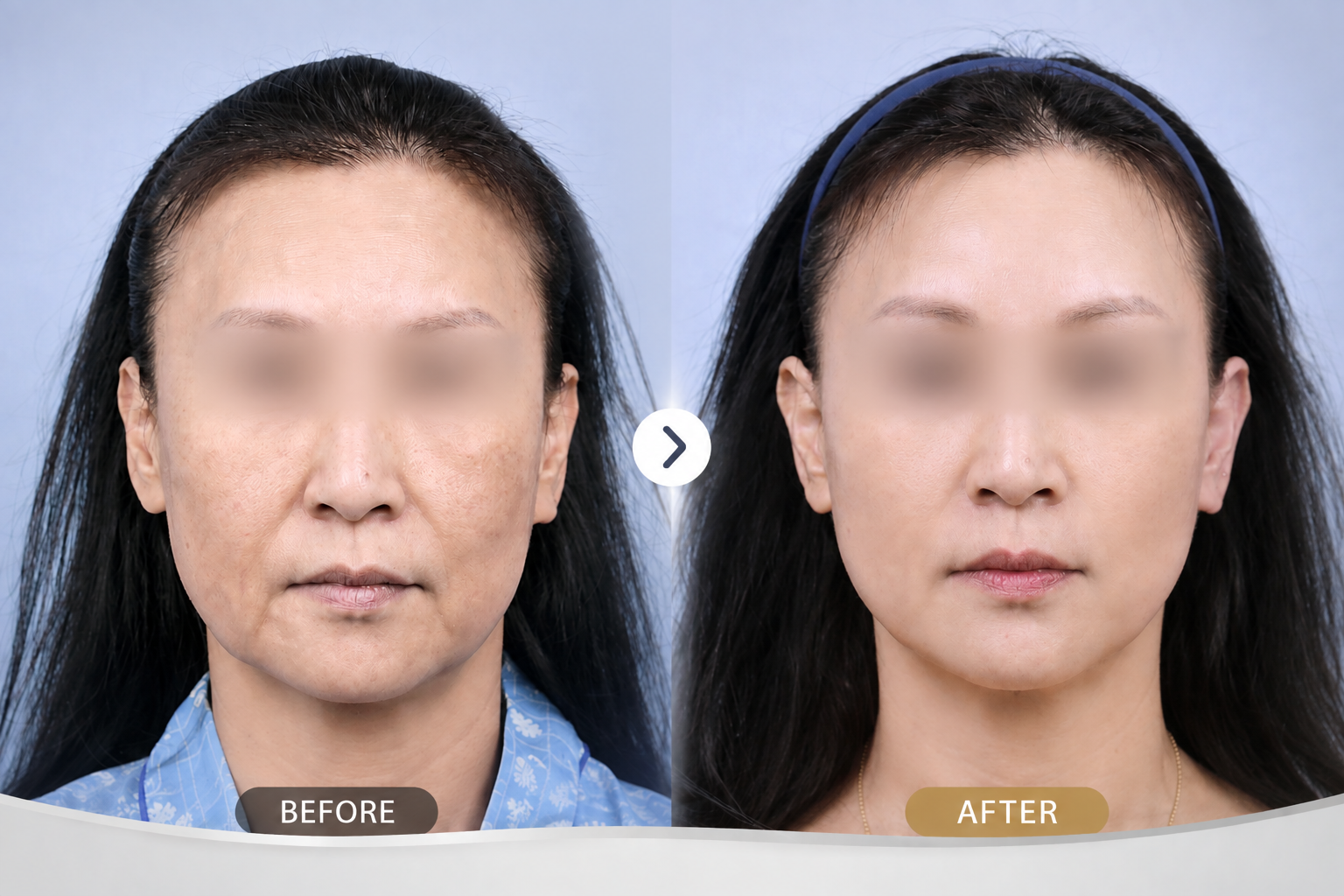
Results vary according to anatomy, degree of sagging, surgical extent, and individual healing. Before-and-after photographs represent individual cases and do not guarantee the same result for every patient.
Facelift vs Thread Lift vs Ulthera
Patients researching lifting treatments in Korea often compare facelift surgery with thread lifting and Ulthera.
The three treatments work differently.
| Facelift | Thread Lift | Ulthera | |
|---|---|---|---|
| Approach | Surgical tissue repositioning | Mechanical support with absorbable threads | Focused ultrasound energy |
| Main Target | More significant facial or neck sagging | Mild to moderate tissue descent | Mild to moderate laxity |
| Incision | Yes | No conventional incision | No |
| Tissue Repositioning | More extensive | Limited | Non-surgical |
| Recovery | Surgical recovery | Relatively limited | Minimal |
Non-surgical lifting may be appropriate when sagging is relatively mild.
When skin and deeper tissues have descended more significantly, however, thread lifting or energy-based treatments may not provide the amount of repositioning the patient expects.
The appropriate treatment should therefore be determined by the degree and location of sagging rather than by treatment popularity alone.
Facelift Surgery & Recovery
The surgical plan and recovery differ depending on whether a full or mini facelift is performed.
| Full Facelift | Mini Facelift | |
|---|---|---|
| Surgery Time | Approx. 2 hours | Approx. 30 min–1 hour |
| Anesthesia | Sedation | Sedation |
| Hospitalization | Not required | Not required |
| Suture Removal | Approx. Day 7 | Approx. Day 7 |
| Follow-Up Visits | Approx. 2–3 | Approx. 1–2 |
Swelling, bruising, tightness, and temporary changes in sensation may occur during early recovery.
Although sutures are generally removed around Day 7, this does not mean the final result has been reached. Swelling continues to decrease and the repositioned tissues gradually settle over time.
International patients should also consider their travel schedule, as postoperative checks may be required before leaving Korea.
Why Choose Signal Plastic Surgery for Facelift Surgery?
Facelift surgery requires more than simply pulling loose skin.
Understanding facial anatomy, the SMAS layer, retaining ligaments, tissue direction, and the appropriate degree of repositioning is important when planning surgery.
At Signal Plastic Surgery, facelift surgery is performed under the care of a board-certified plastic surgeon who also holds a PhD in Medicine.
Rather than choosing a procedure based only on incision length, patients should understand:
- Why a mini or full facelift is being recommended
- Which areas will be lifted
- How deeper tissues such as the SMAS will be addressed
- Whether the neck should be included
- What postoperative follow-up will be required
This allows the surgical plan to be based on the patient’s anatomy and degree of sagging rather than applying the same lifting method to every patient.
Frequently Asked Questions About Facelift Surgery
What is the difference between a mini facelift and full facelift?
The main difference is the extent of surgical correction.
A mini facelift uses a more limited incision and lifting area and may be appropriate for localized or moderate sagging. A full facelift involves broader tissue repositioning and may be considered when sagging affects the cheeks, lower face, jawline, and potentially the neck.
How do I know whether I need a mini facelift or full Facelift in Busan?
The degree and distribution of sagging are more important than age alone.
If the concern is mainly early jowling or localized lower-face laxity, a mini facelift may be considered. If significant sagging extends across the cheeks, jawline, lower face, or neck, a broader facelift may be more appropriate.
A surgical consultation is necessary to determine the appropriate extent.
Does a facelift only tighten loose skin?
No. Facelift planning can involve deeper structures such as the SMAS layer and retaining ligaments rather than simply removing and tightening loose skin.
At Signal Plastic Surgery, these deeper structures are considered when determining the appropriate direction and extent of lifting.
Can I get a facelift after thread lifts or Ulthera?
Previous non-surgical lifting does not automatically prevent facelift surgery, but the surgeon should know about previous treatments.
Patients should provide information about previous thread lifts, ultrasound or RF lifting, and other facial procedures during consultation because this history may be relevant to surgical planning.
Will a facelift make my face look too tight or unnatural?
The objective should not be to pull the skin as tightly as possible.
Facial proportions, deeper tissue positioning, and the direction and degree of lifting all need to be considered. The desired result and realistic expectations should therefore be discussed with the surgeon before surgery.
Does a facelift also improve the neck?
It can, depending on the surgical plan.
When neck laxity, sagging beneath the chin, or a poorly defined jawline is a major concern, the neck may need to be evaluated together with the face.
How much does a Facelift in Korea cost?
At Signal Plastic Surgery, facelift surgery generally ranges from approximately KRW 4 million to KRW 10 million or more, depending on the extent of surgery.
When comparing prices, patients should confirm whether the procedure is a mini facelift, full facelift, face-and-neck procedure, and which areas and surgical steps are included.
Considering a Facelift at Signal Plastic Surgery in Busan?
When considering facelift surgery, the first question does not necessarily have to be:
“Should I choose a mini facelift because the incision is smaller?”
A more useful question is:
“Where is my facial tissue sagging, and how much repositioning is actually needed?”
At Signal Plastic Surgery, the cheeks, nasolabial folds, jawline, neck, and deeper supporting tissues can be evaluated before determining whether a mini facelift, full facelift, or another lifting approach may be appropriate.
For international patients considering a Facelift in Busan, understanding the surgical extent, expected recovery, follow-up requirements, and cost can help make the treatment decision clearer.