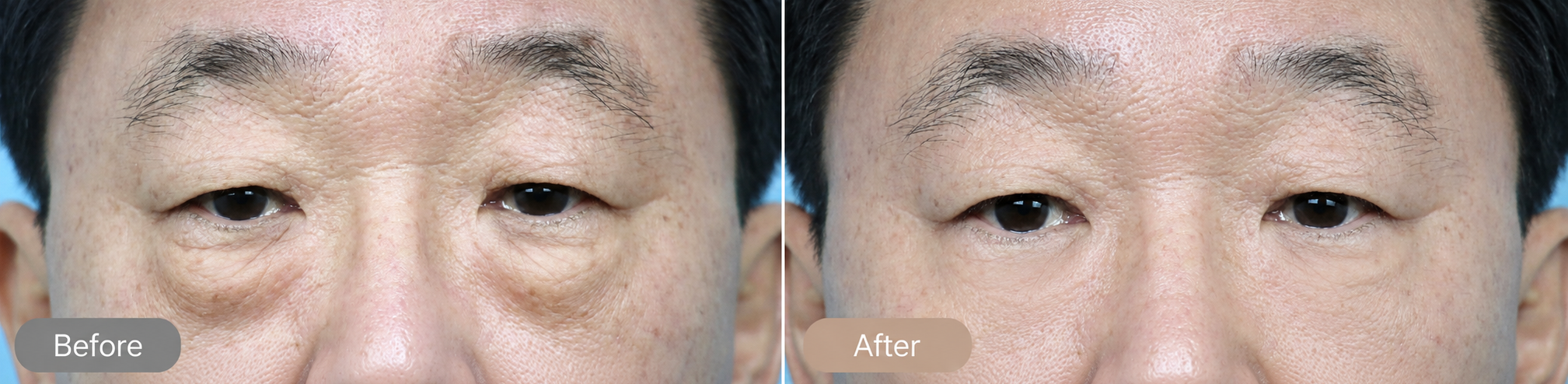
Under-eye bags, loose skin, and wrinkles can make the eyes look tired or older even when you feel well rested.
These changes often become more noticeable with age as the lower-eyelid skin loses elasticity and the fat beneath the eyes becomes more prominent.
Lower Blepharoplasty in Busan at Signal Plastic Surgery is designed for patients who have under-eye concerns involving not only protruding fat, but also loose skin and wrinkles.
Unlike under-eye fat repositioning alone, lower blepharoplasty can address excess lower-eyelid skin while managing the underlying fat according to the patient’s anatomy.
- What Is Lower Blepharoplasty?
- Who May Consider Lower Blepharoplasty?
- Lower Blepharoplasty vs Lower Eyelid Fat Repositioning
- Why Isn’t Fat Repositioning Always Enough?
- Lower Blepharoplasty and Dark Circles
- Lower Blepharoplasty Surgery Information & Cost
- Recovery After Lower Blepharoplasty
- Why Choose Signal Plastic Surgery for Lower Blepharoplasty in Busan?
- Frequently Asked Questions About Lower Blepharoplasty
- Considering Lower Blepharoplasty in Busan?
What Is Lower Blepharoplasty?
Lower blepharoplasty is a surgical procedure used to improve aging changes around the lower eyelids.
Depending on the patient’s anatomy, surgery may address:
- Protruding under-eye fat
- Excess or sagging lower-eyelid skin
- Under-eye wrinkles
- Uneven lower-eyelid contours
- Tear trough hollows
- Shadows that contribute to a tired appearance
An incision can be placed just below the lower lash line when excess skin needs to be removed.
Through this approach, the surgeon can manage loose skin while removing or repositioning appropriate under-eye fat according to the surgical plan.
The goal is not simply to make the lower eyelid tighter, but to create a smoother and more balanced transition between the lower eyelid and cheek.

Who May Consider Lower Blepharoplasty?
Lower blepharoplasty may be considered if you:
- Have noticeable wrinkles beneath the eyes
- Have prominent under-eye bags that create a tired appearance
- Have significant lower-eyelid skin laxity
- Feel that sagging beneath the eyes makes you look older
- Have under-eye bags together with contour-related dark shadows
- Want to improve both excess skin and under-eye fat
Lower blepharoplasty is commonly considered by patients in their 40s, 50s, and 60s as skin laxity and wrinkles become more noticeable.
However, age alone does not determine the appropriate procedure.
A younger patient with significant excess skin may require a different approach, while an older patient with relatively good skin elasticity may not require the same amount of skin removal.
The decision should be based on skin laxity, wrinkles, fat position, tear trough anatomy, and lower-eyelid support.
Lower Blepharoplasty vs Lower Eyelid Fat Repositioning
One of the most common questions is whether you need lower blepharoplasty or lower eyelid fat repositioning.
The main difference is whether excess skin and wrinkles also need to be treated.
| Lower Eyelid Fat Repositioning | Lower Blepharoplasty | |
|---|---|---|
| Main Concern | Under-eye fat bulging and tear trough hollowing | Under-eye bags with loose skin and wrinkles |
| Skin Laxity | Minimal | More noticeable |
| Wrinkles | Limited | More prominent |
| Typical Approach | Inside the lower eyelid | Below the lower lash line when skin removal is required |
| Fat Treatment | Fat repositioning | Fat may be repositioned or removed as needed |
| Skin Removal | No with a transconjunctival-only approach | Yes, when indicated |
| Common Age Group | Often 20s–30s | Often 40s–60s |
| Price at Signal | Low-KRW 2 million range | Low-KRW 2 million range |
The age ranges above are only general tendencies.
For example, a patient in their 30s with significant skin laxity should not automatically choose fat repositioning simply because they are younger.
Similarly, being in your 50s does not automatically mean that the same lower blepharoplasty technique is appropriate for you.
Why Isn’t Fat Repositioning Always Enough?
Lower eyelid fat repositioning can be a good option when the primary concerns are protruding fat and tear trough hollowing and the skin still has relatively good elasticity.
However, repositioning fat does not remove excess lower-eyelid skin.
If significant wrinkles and loose skin are already present, improving the fat distribution alone may leave the skin-related concern untreated.
Lower blepharoplasty allows the surgeon to address the excess skin while also managing the underlying fat when necessary.
This is why determining the source of the problem is important before choosing between the two procedures.
Lower Blepharoplasty and Dark Circles
Some patients consider lower blepharoplasty because their dark circles make them look constantly tired.
However, not all dark circles have the same cause.
Under-eye bags, hollows, and loose skin can create shadows that make the area look darker. Improving the contour may therefore reduce shadow-related darkness in selected patients.
But dark circles may also be related to:
- Skin pigmentation
- Thin lower-eyelid skin
- Visible blood vessels
- Genetics
- Other skin-related factors
Lower blepharoplasty should therefore not be presented as a treatment that removes every type of dark circle.
The cause of the dark appearance should first be evaluated.
Lower Blepharoplasty Surgery Information & Cost
Procedure : Lower Blepharoplasty
Main Concerns : Under-eye bags, loose skin, wrinkles and uneven lower-eyelid contour
Treatment Area : Lower eyelids
Surgical Approach : Determined according to skin laxity, fat position and individual anatomy
Skin Removal : Performed when excess lower-eyelid skin is present
Fat Management : Fat may be repositioned or removed according to the surgical plan
Price : Low-KRW 2 million range
Lower eyelid fat repositioning is also generally available in the low-KRW 2 million range at Signal Plastic Surgery.
The final price is confirmed after consultation because the required surgical technique and extent of correction can differ between patients.
Recovery After Lower Blepharoplasty
Swelling and bruising are expected during the early recovery period.
Because lower blepharoplasty may involve an external incision and skin removal, recovery can differ from transconjunctival fat repositioning alone.
Patients may temporarily experience:
- Swelling
- Bruising
- Tightness
- Tenderness
- Dryness or irritation around the eyes
- Temporary changes in sensation around the incision
The final lower-eyelid contour should not be judged during the early swollen stage.
The appearance gradually becomes more defined as swelling resolves and the incision continues to mature.
International patients should plan sufficient time in Korea for postoperative checks and any required suture removal before arranging their return flight.
Why Choose Signal Plastic Surgery for Lower Blepharoplasty in Busan?
Lower-eyelid surgery requires careful evaluation because removing too much skin or fat can affect the appearance and support of the lower eyelid.
Signal Plastic Surgery is led by a board-certified plastic surgeon with an M.D. and Ph.D. and experience as a former university hospital professor.
Before surgery, the treatment plan considers:
- Amount of excess skin
- Under-eye wrinkles
- Position and amount of lower-eyelid fat
- Tear trough hollowing
- Lower-eyelid support
- Facial symmetry
- Previous eyelid surgery
- Overall balance between the lower eyelid and cheek
Rather than deciding on surgery based only on age, the surgeon evaluates whether the main concern comes from skin, fat, hollowing, or a combination of these factors.
Signal Plastic Surgery also provides pre-visit consultation assistance and medical interpretation support for international patients planning eyelid surgery in Busan.
Frequently Asked Questions About Lower Blepharoplasty
How do I know if I need lower blepharoplasty or under-eye fat repositioning?
The main question is whether excess skin and wrinkles also need to be treated.
If the primary concern is protruding fat and tear trough hollowing with relatively good skin elasticity, fat repositioning may be considered. If loose skin and noticeable wrinkles are also present, lower blepharoplasty may be more appropriate.
Am I too young for lower blepharoplasty?
There is no strict age requirement.
Fat repositioning is commonly considered in younger patients with good skin elasticity, while lower blepharoplasty becomes more common as excess skin and wrinkles develop. However, your anatomy is more important than your age.
Will I have a visible scar after lower blepharoplasty?
When excess skin is removed, the incision is generally positioned just below the lower lash line so that the scar can become less noticeable as it matures.
Scar appearance varies according to surgical technique and individual healing.
Does lower blepharoplasty remove dark circles?
It may improve dark shadows caused by under-eye bags, hollows, or uneven contours.
However, it does not necessarily improve dark circles caused primarily by pigmentation, thin skin, or visible blood vessels.
Can lower blepharoplasty make my eyes look hollow?
Removing too much fat can contribute to an unwanted hollow appearance.
For this reason, the surgeon should evaluate whether fat should be removed, preserved, or repositioned rather than automatically removing all visible under-eye fat.
How long does lower blepharoplasty recovery take?
Swelling and bruising are expected during the early recovery period and gradually improve.
Because healing varies between patients, you should follow your surgeon’s postoperative schedule rather than choosing surgery based on a fixed recovery timeline.
Is lower blepharoplasty more invasive than fat repositioning?
When lower blepharoplasty includes an external incision and removal of excess skin, it is generally a more extensive procedure than transconjunctival fat repositioning alone.
However, the exact surgical extent depends on the individual treatment plan.
How much does Lower Blepharoplasty in Busan cost?
At Signal Plastic Surgery, Lower Blepharoplasty in Busan is generally in the low-KRW 2 million range.
Lower eyelid fat repositioning is also generally in the low-KRW 2 million range. The final price depends on your anatomy and required surgical plan.
How long should I stay in Korea after lower blepharoplasty?
International patients should allow enough time for early postoperative checks and suture removal when required.
Your recommended stay should be confirmed with the clinic after your surgical plan has been determined.
Can lower blepharoplasty and fat repositioning be performed together?
Yes, depending on the patient’s anatomy.
Lower blepharoplasty may involve removal of excess skin while the lower-eyelid fat is repositioned or selectively removed. The appropriate combination depends on skin laxity, fat distribution, hollowing, and lower-eyelid support.
Considering Lower Blepharoplasty in Busan?
If your under-eye concern involves loose skin and wrinkles as well as protruding fat, fat repositioning alone may not address every part of the problem.
The key question is not simply:
“How old am I?”
It is:
“Is my under-eye concern mainly caused by fat, loose skin, or both?”
At Signal Plastic Surgery, the surgical plan is determined after evaluating lower-eyelid skin laxity, wrinkles, fat position, tear trough anatomy, and eyelid support.
For international patients considering Lower Blepharoplasty in Korea, pre-visit consultation can help determine whether lower blepharoplasty, lower eyelid fat repositioning, or a combination of techniques is more appropriate before traveling to Busan.